

Drive twenty minutes west from Fremont Street and your odds of a break-in shift by a factor of four. Mid-2026 figures from CrimeGrade put the yearly burglary risk in the central neighborhoods at roughly 1 in 123, against about 1 in 489 out in the southwest valley. Same city, same police radio, and a completely different experience of owning a house. I’ve bought on both ends of that spread. The paperwork looks identical, and what you live with afterward doesn’t.
Nobody explains that part at an open house. The loan estimate, the title commitment, and the seven-day inspection window all read the same whether the house sits in The Ridges or three blocks off Boulder Highway. Year three is when the difference shows up, when you’re deciding whether to leave the garage door open while you carry in groceries.
What Are the Safest Neighborhoods in Las Vegas?
Zip code 89135 in Summerlin South runs a violent crime rate around 20.7 per 100,000 residents, which sneaks in just under the national mark. Anthem and Seven Hills over in Henderson sit near 2.1 violent crimes per 1,000 people, against roughly 9.5 per 1,000 valleywide.
The whole story of buying in this valley is that gap. Summerlin, Anthem, Seven Hills, The Ridges, Southern Highlands, and the Inspirada area of Henderson all cluster in the same band. They’re master-planned, with heavy HOA presence, newer construction, and fewer through-streets for anyone casing a block. Green Valley Ranch belongs on the list too. From the offers I’ve written as one of the cash buyers in Henderson, it prices a little friendlier than Summerlin for a similar feel.
Street design does more work than people give it credit for. Loop roads and single-entry pods mean anyone driving through has a reason to be there, and passing cars get noticed. Newer builds also come with better hardware by default: solid-core front doors, deeper strike plates, pre-wired alarm panels, and from what I’ve noticed walking these houses, that matters more than a gate does.
Worth saying plainly: none of these are gated bubbles. Summerlin still logs package theft and car break-ins. What changes is the frequency and the severity. Over a ten-year hold, frequency is what wears you down, at least that’s what I’ve seen holding rentals that long.
Which Areas Should Buyers Approach Carefully?
The historic core around Fremont, parts of 89101 and 89106, and pockets of east Las Vegas near Boulder Highway carry the heaviest crime numbers in the metro. I noticed that firsthand scouting properties there. Naked City, immediately north of the Strip, is the one most agents will quietly steer you away from. North Las Vegas has improved a lot in the last decade, though it’s still uneven block to block in a way the zip-code averages hide.
I don’t write these areas off. Cash-flow investors do well in the east valley, and some of the older ranch homes near downtown sit on lots you simply cannot buy anywhere else for the money. Still, if you’re financing a primary residence, raising kids, and planning to sleep well, understand what you’re signing up for. Insurance runs higher. Resale is slower. You’ll spend money on cameras, a better door, and a garage you actually use.
Buyers run into a few practical snags here too. Older stock near the core often means original electrical panels, galvanized supply lines, and evaporative coolers instead of central air. All fixable, none cheap, and some of it will come up as a lender condition rather than a wish-list item. Appraisals get harder when the comps within a half-mile include a boarded-up flip and a fully renovated bungalow. And if you’re buying with a low down payment, budget for the insurance carrier to ask questions the Summerlin buyer never hears: roof age, prior claims, whether the property will sit vacant during renovation.
What Does Safety Cost in Real Dollars?
Roughly $200,000, give or take, at the extremes.
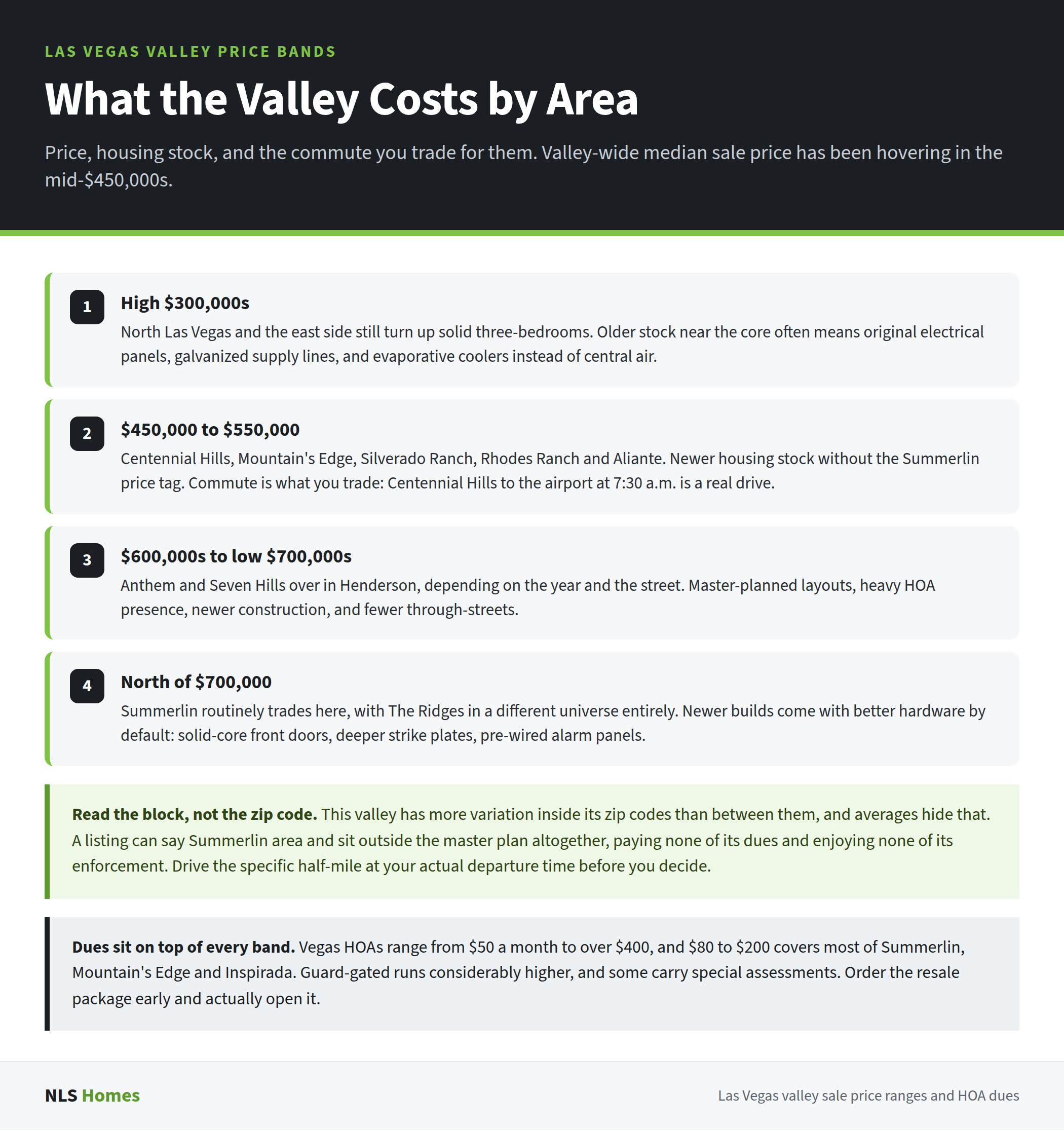
Valley-wide median sale price has been hovering in the mid-$450,000s. Summerlin routinely trades north of $700,000, with The Ridges in a different universe entirely. Henderson’s Anthem and Seven Hills land somewhere in the $600,000s to low $700,000s, depending on the year and the street. North Las Vegas and the east side still turn up solid three-bedrooms in the high $300,000s, and those are the blocks where a buyer can still find real value.
That premium buys you more than a crime statistic. It buys schools that hold their ratings, an HOA that enforces the paint colors, and a resale pool of buyers who will compete for your house in a soft market. I’ve seen it play out when flipping in similar neighborhoods. Whether it’s worth $200,000 to you is a math problem only you can run.
Run it honestly, though. The premium isn’t just the price on the contract. It flows into your Clark County property tax bill, your insurance, your HOA dues, and the payment you’ll carry for as long as you hold the loan. Two buyers with identical incomes can end up in very different financial shape, depending on which side of that spread they picked. The one who bought less house sometimes ends up with the stronger balance sheet, something I’ve watched more than once in sales I’ve closed. The counterweight is exit liquidity. When the market cools, homes in the strong corridors sit for weeks; homes in the weaker ones sit for months and then negotiate.
Where’s the Middle Ground?
This is where most buyers should be looking and often aren’t.
Centennial Hills in the northwest, Mountain’s Edge and Silverado Ranch in the south, and the Rhodes Ranch area all deliver newer housing stock. Crime numbers there run well under the valley average, without the Summerlin price tag. Aliante in North Las Vegas is the one that surprises people; it’s a master-planned pocket that performs nothing like the zip code around it. Expect the $450,000 to $550,000 range in most of these.
Commute time is what you’re really trading away here. Centennial Hills to the airport at 7:30 a.m. is a real drive, and the 215 does not care about your calendar. Before you fall for a floor plan, drive your actual commute at your actual departure time, not on a Saturday, and not from the model home parking lot. A family with one parent working near the Strip and another in Henderson usually lands somewhere central, like Silverado Ranch, and gives up some square footage for it. That’s a fair trade if you’ve made it deliberately.
What I’d Check Before I Signed
Pull the crime map for the specific half-mile, not the neighborhood name. Boundaries in this valley are sharp, especially the City of Las Vegas line, and marketing copy is generous. A listing can say “Summerlin area” and sit outside the master plan altogether, paying none of its dues and enjoying none of its enforcement.
Drive the street at 10 p.m. on a Friday and again on a Sunday morning. You’ll learn more in those two trips than any report could tell you. Look for whether cars park in garages or on lawns, whether the streetlights work, whether the corner house has a dog that barks at everything. Talk to whoever’s out watering. People tell you the truth about a block when they have nothing to gain.
Read the HOA docs before the inspection, not after. Vegas HOAs range from $50 a month to over $400, and some of the guard-gated communities carry special assessments that show up on nobody’s affordability calculator. Order the resale package early and actually open it. The meeting minutes will tell you whether the board is arguing about roofs or about mailbox colors, and that difference matters. If the community’s got sub-associations, confirm whether you owe one dues bill or two.
The water bill is worth a close look before you make an offer. Southern Nevada Water Authority turf rules and tiered rates mean a big lawn is a recurring cost, not a one-time landscaping decision. Ask the seller for a year of statements rather than a summer average, since the peak months are the ones that hurt. A previous owner who let the grass die won’t show you what it really costs to keep it green.
Check the school attendance zone directly with CCSD. Zones get redrawn, and the listing sheet is not a legal document. If a specific school is the reason you’re buying, verify it in writing and ask whether the campus is at capacity, because that’s usually the first sign a boundary is about to move.
Frequently Asked Questions
Is Summerlin actually safer than Henderson?
They’re close enough that the distinction rarely matters. Summerlin South’s 89135 and Henderson’s Anthem and Seven Hills all run well below national violent crime rates. Pick on commute, HOA rules, and price, not on a two-point difference in a crime index.
Are the older downtown neighborhoods worth the risk for an investor?
Sometimes. Rents have climbed, the lots are larger than anything new, and the Arts District has genuine momentum. Just underwrite for higher vacancy, higher insurance, and a longer sale when you exit.
How much HOA should I expect in a master-planned community?
Budget $80 to $200 a month for most of Summerlin, Mountain’s Edge, and Inspirada. Guard-gated runs considerably higher. Always ask whether the reserve study is current.
Does North Las Vegas deserve its reputation?
Partly, and less than it used to. Aliante and the newer tracts near the 215 perform like suburban Henderson. Older sections closer to the core don’t. It’s a city where the block matters more than the name.
What’s the single biggest mistake buyers make here?
Trusting the zip code. Las Vegas has more variation inside its zip codes than between them, and the four-to-one burglary spread I opened with can show up within a fifteen-minute drive.
If you’re weighing a few of these areas against each other and the numbers aren’t sorting themselves out, it’s worth talking through with the NLS Homes team, which tracks the valley block by block. No rush, no obligation to list or buy anything, and you can check out other frequent questions first. Sometimes a twenty-minute conversation saves you from that costly assumption.