

Smoke does more damage than flame in most of the house fires I’ve walked through. The fire stays in one room. Soot goes everywhere: into the ductwork, behind the drywall, into the textured ceiling of a 1970s ranch off Eastern Avenue. The gap between what burned and what smells burned is where sellers get turned around. It’s also where offers start swinging by tens of thousands of dollars. If your property took a fire and you’re trying to figure out the next move, you have real options. None of them require you to rebuild first.
Can You Sell a Fire-damaged House in Las Vegas?
A burned house sounds unsellable. Wait for the insurance money, put the house back together, then list it like nothing happened: that’s the plan almost everyone starts with. It usually comes apart around the third week. The insurance adjuster’s scope of repair doesn’t line up with what a licensed contractor will actually sign a contract for, and the homeowner is paying a mortgage on a house nobody can live in.
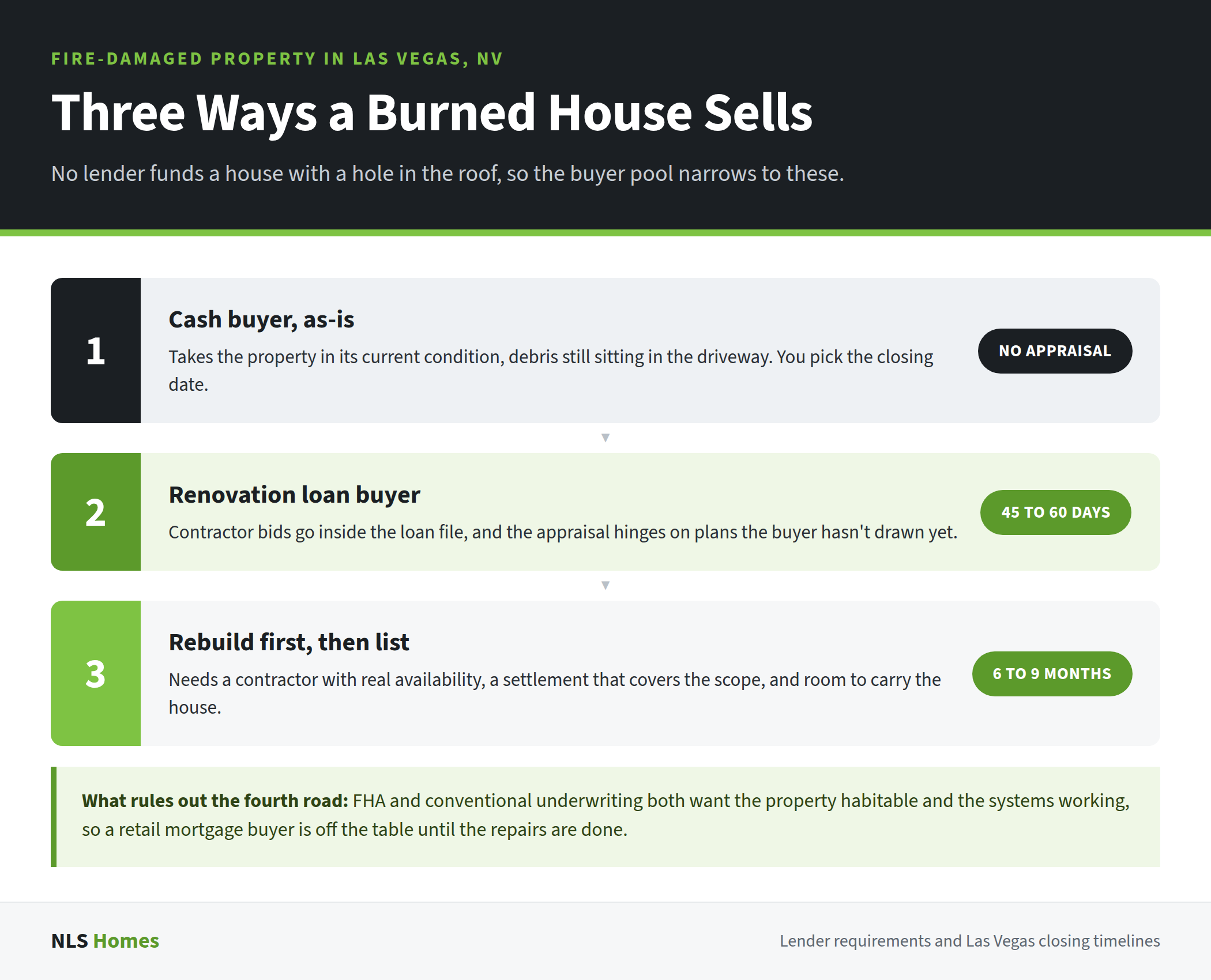
Fire-damaged properties in Las Vegas sell every single month. They sell to investors, to contractors who want a project, to neighbors who want the lot, and to buyers who pay cash and don’t care that the kitchen is charcoal. What they don’t do is sell to a buyer using a conventional mortgage loan. No lender funds a house with a hole in the roof.
Know your baseline, because everything else gets measured against it. Las Vegas REALTORS® reported the median price of an existing single-family home in Southern Nevada at $475,000 in August 2026, off about 1% from a year earlier. That comes from local coverage of the LVR numbers. Your fire-damaged house isn’t worth that. Still, the figure anchors the math. A buyer works backward from repaired value, then subtracts the rebuild, the holding costs, and the profit.
A couple of years ago I bought a small three-bedroom in Charleston Heights. The young couple who owned it had inherited the house, rented it out, and never wanted to be landlords in the first place. A tenant’s grease fire took the kitchen and half the hallway ceiling on a Sunday night. They were done chasing rent checks. The chest freezer in the garage still had someone else’s food in it. They told me they’d rather take one clean payment than manage a rebuild from two states away.
What to Do First After a House Fire in Las Vegas
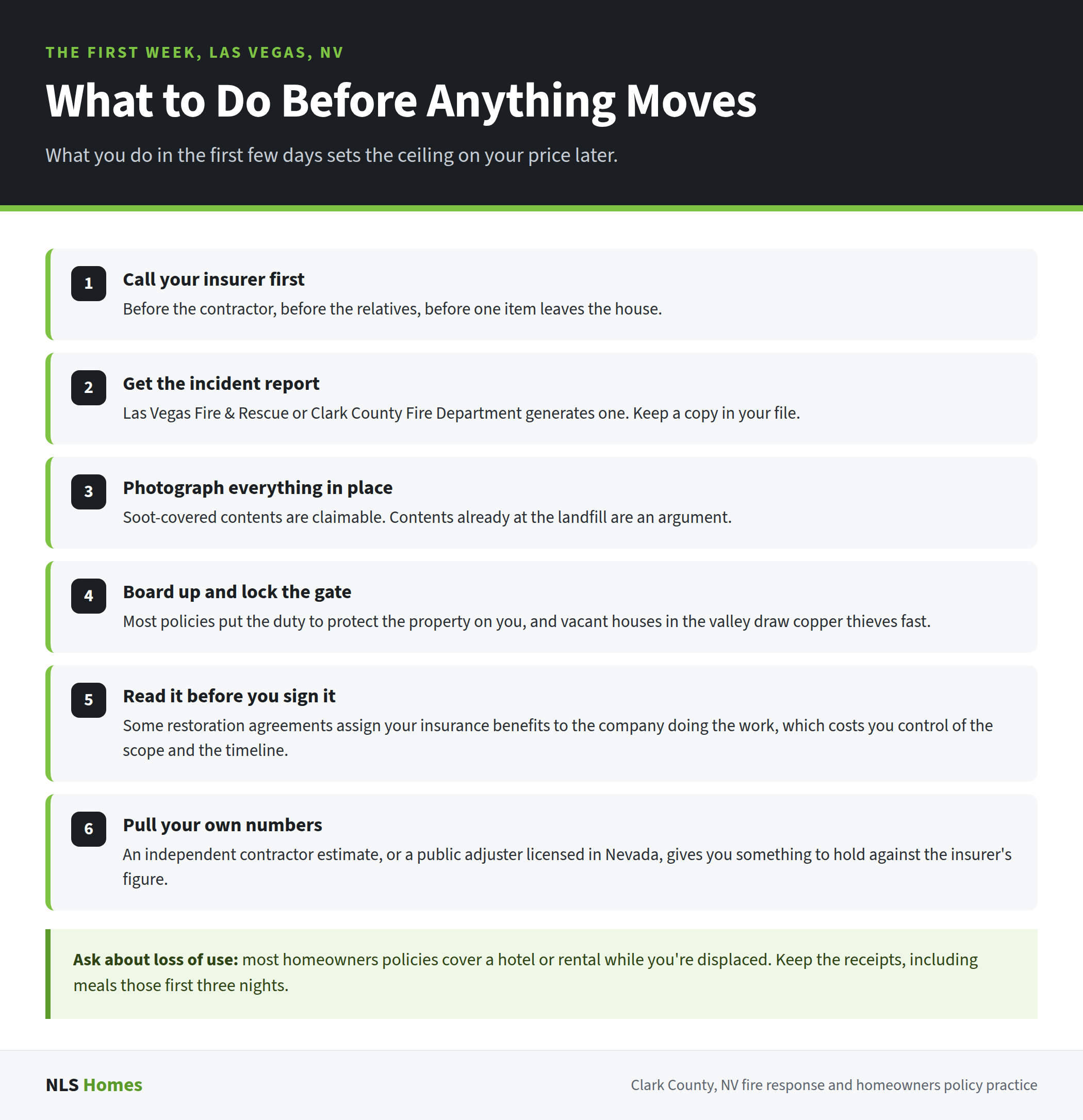
Which raises the question of the first week, because what you do in those days sets the ceiling on your price later. Call your insurer before you call anybody else. Whichever agency responded, Las Vegas Fire & Rescue or Clark County Fire Department, will generate an incident report. You want a copy of it in your file. I ask sellers for that report upfront, because it heads off disputes later.
Photograph everything before a single item leaves the house. I’ve watched sellers lose thousands because a well-meaning relative hauled a truckload to the dump before the insurance company documented it. I nearly missed that one myself. Soot-covered contents are claimable. Contents in a landfill are an argument.
Board up the openings and lock the gate. Vacant fire-damaged houses in the valley attract copper thieves fast, sometimes within days of the fire. Most policies put the duty to protect the property on you as the policyholder. Coverage for a hotel or rental while you’re displaced sits in most homeowners policies under loss of use, so ask your adjuster about it specifically. Keep receipts for everything, including the meals you ate out the first three nights.
Have you read what the restoration contractor handed you to sign? Some of those agreements include an assignment of benefits, which hands your insurance claim over to the company doing the work. I’d think hard before signing one. Once your claim is assigned, you lose leverage over both the scope and the timeline. You’ve also complicated any future sale of the property.
Pull your own numbers before you agree to anything. An independent estimate from a general contractor, or a public adjuster licensed in Nevada, gives you something to hold up against the insurer’s figure. When those two documents disagree by a wide margin, that gap is your negotiating room. It works that way whether you rebuild or sell as-is.
Nevada Laws You Need to Know Before Selling Fire-damaged Property
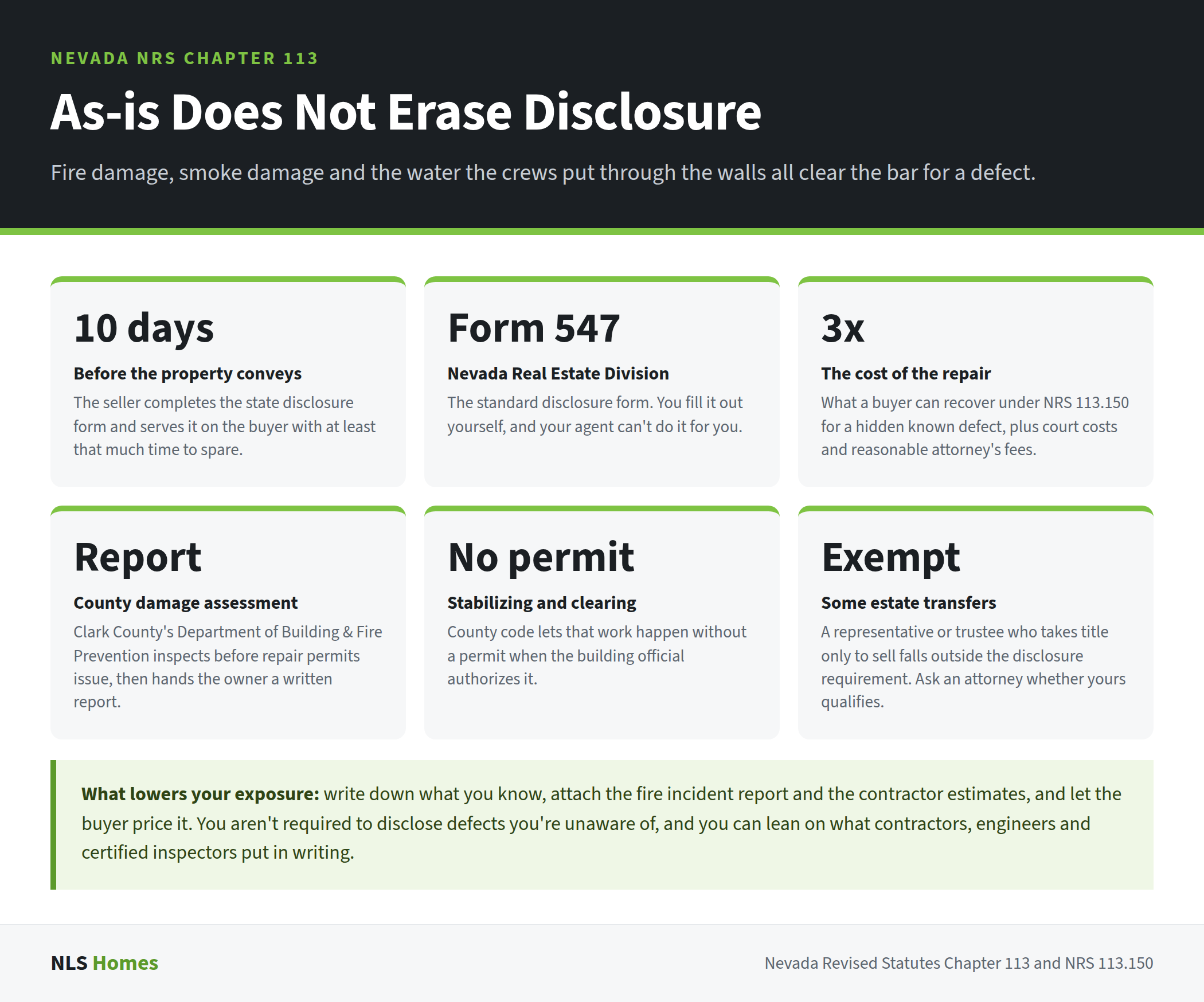
Ten days. Under NRS Chapter 113, a seller has to complete the state’s disclosure form and serve it on the buyer at least 10 days before the residential property is conveyed. The form itself is Form 547 from the Nevada Real Estate Division. You fill it out yourself, and your agent can’t do it for you.
Under Nevada law, a defect is any condition that hurts the value or use of the property in an adverse way. Fire damage clears that bar without argument. Smoke damage does too, along with the water the fire crews put through the walls.
Selling as-is doesn’t erase the disclosure duty. This is the single most expensive misunderstanding I run into with fire sellers. Hide a known condition and the buyer’s remedy under NRS 113.150 is triple the cost of repairing that defect, plus court costs and reasonable attorney’s fees. Write down what you know, attach the fire report, attach the contractor estimates, and let the buyer price it.
You’re not required to disclose defects you’re unaware of. Nevada law says so plainly, and sellers can also lean on information given to them by contractors, engineers, and certified inspectors. Getting things in writing from professionals rather than guessing on the form is another reason.
Estate sales work differently. When a personal representative or trustee takes title temporarily just to sell a deceased person’s house, that transfer falls outside the disclosure requirement. A real estate attorney can tell you in one phone call whether your situation qualifies. That call is worth making before you sign anything.
You’ll need to handle permits too. The Clark County Building and Fire Prevention department offers an on-site damage assessment inspection before repair permits get issued, and the inspector hands the owner a written report afterward. The report is a useful document for a buyer. County code lets stabilization work and debris clearing happen without a permit when the building official authorizes it.
Should You Repair the Fire Damage or Sell As-is?
“Is it even worth fixing?”
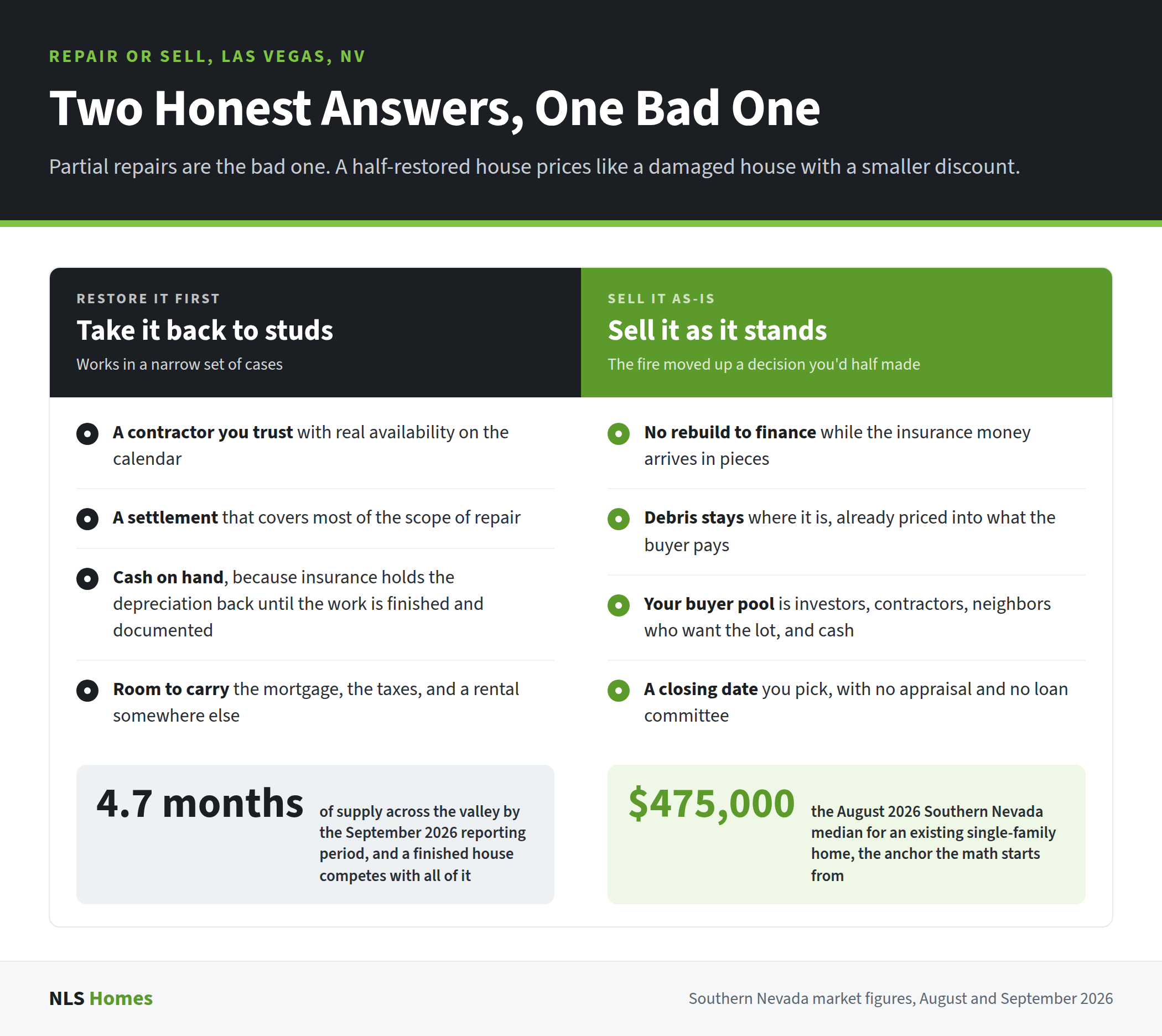
I get asked that in some form on nearly every fire call. My answer starts with a different question: who’s paying, and how fast does the money arrive? Insurance proceeds on a partial loss usually come in pieces, with the depreciation held back until the work is finished and documented. That means you’re fronting cash or financing the gap yourself.
Partial repairs are almost always wasted money. Painting over soot, swapping the burned cabinets, leaving the ductwork and the attic insulation alone: buyers smell it during the walkthrough, and your inspections will catch it anyway. A half-restored house prices like a damaged house with a smaller discount on the front end. Either take the structure back to bare studs with a proper remediation crew, or sell it honestly in the condition it’s in.
Full restoration makes sense in a narrow set of cases. You have a general contractor you trust with real availability, and your insurance settlement covers most of the scope. You can carry the mortgage, the taxes, and a rental somewhere else for six to nine months without wrecking your finances. Strip any one of those away and the renovation math turns against you.
You should weigh market conditions in that decision too. Supply across the valley climbed to roughly 4.7 months by the September 2026 reporting period. A rebuilt house won’t sell into the bidding-war environment of a few years back. Finish your renovations and you’re competing against clean, move-in-ready inventory with nothing to explain.
Selling as-is isn’t quitting. For a lot of homeowners, particularly people who’d already been thinking about moving, the fire just moved up a decision they’d half made. Take the settlement, take the sale price, and go buy something that doesn’t smell like a campfire.
How Do You Get the Best Price for a Fire-damaged Home?
A seller called me with a bedroom fire and one offer in hand. A wholesaler had knocked on her door two days after the trucks left. She took a week, got two more offers, and closed for noticeably more than that first number without doing any work to the house.
Never take the first knock. Fire-damaged properties draw door-knockers who count on panic, and the antidote is boring: get three written offers and compare them line by line. Look at who’s actually closing versus who’s assigning the contract to someone else.
Documentation raises your price more than cleanup does. A buyer paying cash is underwriting risk, and every unknown gets priced as a worst case. Hand over the fire incident report, the adjuster’s scope, your independent estimate, and any damage assessment from the county. You’ve removed the guesswork that was costing you money.
Understand what you’re selling. If your claim hasn’t settled, you may be selling the house and keeping the insurance proceeds. You may instead be negotiating a price that reflects the buyer taking over the claim. Those are two very different transactions with two very different prices, and mixing them up is how sellers leave money behind. Your insurance company can confirm what’s assignable under your policy.
Ask for a comparative market analysis that uses as-is comps, not retail comps. Burned and heavily distressed sales do happen in the valley, and an experienced broker can pull them. That matches what I’ve seen pulling these comps myself. Condo owners should know their starting point is different. The median for existing condos and townhomes in Southern Nevada came in at $299,900 in August 2026, a touch above the prior year.
One more piece of leverage: time. A seller who can wait four weeks gets better numbers than one who needs to close Friday. Local buyers like NLS Homes will give you a straight number on a fire-damaged property without an inspection contingency. Having that offer in your pocket makes every other conversation easier.
Cash Buyers vs Listing on the Market: Which Sells Faster in Las Vegas?
Picture two identical houses in the southwest valley with identical kitchen fires. One went on the MLS at a retail price minus a repair credit and sat through four financing failures. The other closed to a cash buyer in eleven days.
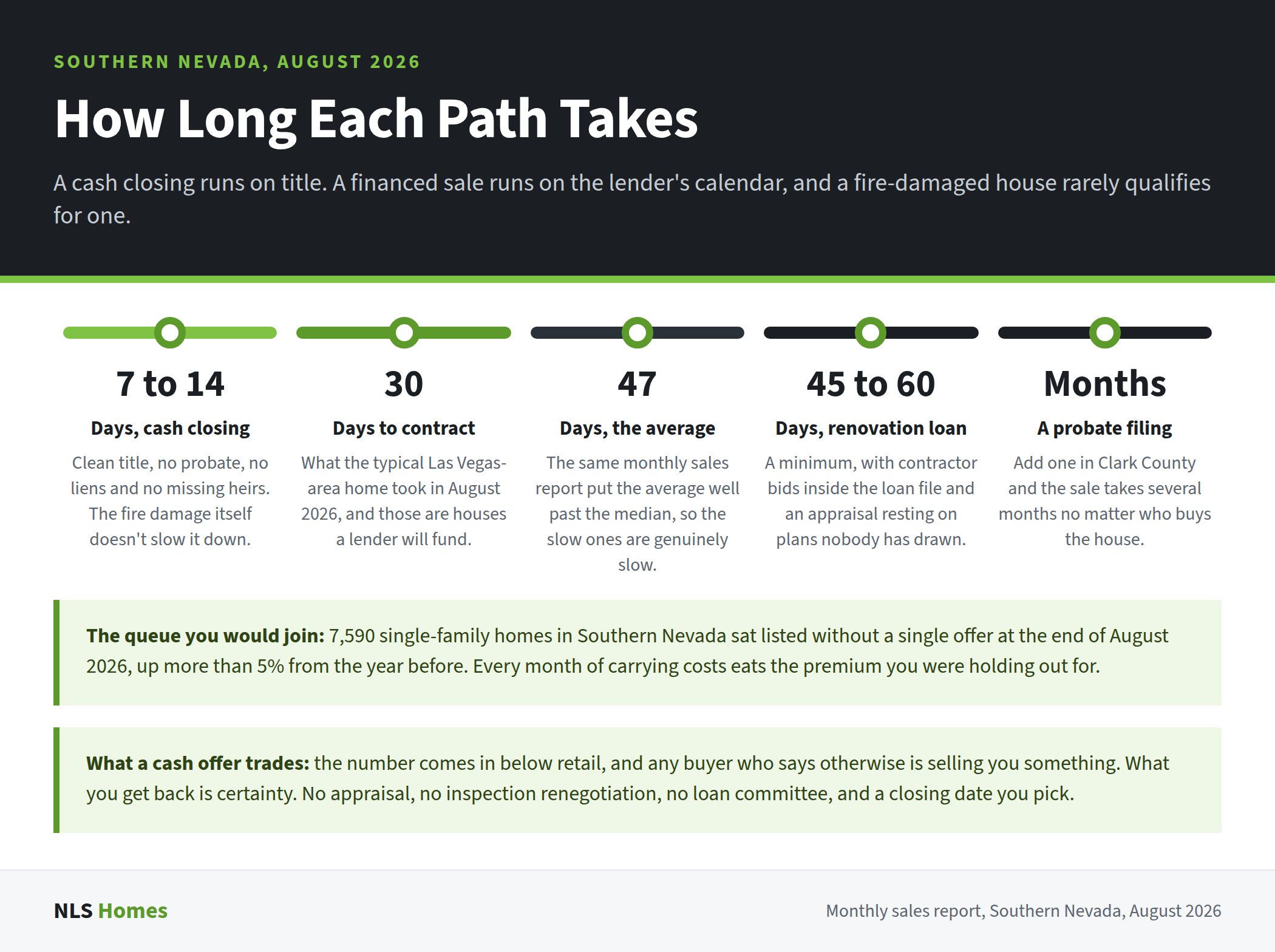
Speed isn’t really the question. Financeability is. In August 2026, the typical Las Vegas-area home went under contract in about 30 days, though the average stretched to 47 days per the monthly sales report. Those timelines describe houses a lender will fund. A fire-damaged house isn’t one of them. FHA and conventional underwriting both want the property habitable and the systems functional, so your buyer pool shrinks to cash and renovation loans.
Renovation financing exists, but plan on 45 to 60 days minimum, contractor bids inside the loan file, and an appraisal that hinges on plans the buyer hasn’t drawn yet. I’ve had those sales close beautifully. I’ve also had them die in week seven.
Inventory is the other pressure. At the end of August 2026, 7,590 single-family homes in Southern Nevada sat listed without a single offer, up more than 5% from the year before. Your damaged house joins that queue if you list it, and every month of carrying costs eats the premium you were holding out for.
A cash offer will come in below retail. That’s the trade, and any buyer who tells you otherwise is selling you something. What you get back is certainty: no appraisal, no inspection renegotiation, no loan committee, and a closing date you pick. Contact NLS Homes or a company like it, and they’ll handle the title work and take the property as is, debris still sitting in the driveway.
Which matters more to you right now, the highest possible number or a date on the calendar you can count on? There’s no wrong answer, but pick one and stop trying to have both.
How Do You Find a Top Real Estate Agent Near You in Las Vegas?
If you’re going to list it, hire someone who’s sold a burned house before, not just a pretty one in Summerlin.
Most Las Vegas real estate agents will never handle a fire property in their whole career. That’s not a knock on them. It means the person marketing your house needs a specific skill set. That’s writing the listing so the damage is disclosed without scaring off every investor, knowing which buyers close, and pricing off distressed comps instead of neighborhood averages.
Interview three. Ask each one how many as-is or distressed properties they closed in the past two years, and ask for the addresses so you can check them. A REALTOR® who works with Las Vegas investors regularly will have a buyer list ready before the sign goes in the yard.
Get the license verified through the Nevada Real Estate Division, and read the listing agreement’s term. Six months on a fire-damaged house with the wrong broker is six months of mortgage payments you can’t get back.
Skip the agent entirely when you need to sell your Enterprise property faster and the damage is severe. Paying a commission to market a house to a buyer pool of twenty local investors rarely pencils out, and those investors will talk to you directly.
Last spring I worked with a woman settling her father’s estate in Paradise Palms. An electrical fire had taken the back bedroom and smoked up the rest of the house. Then her employer transferred her out of state with five weeks to be out. His workbench and about forty years of tools were still in the garage. We closed before her move date, she took what she wanted from that garage, and the rest stayed with the house.
Frequently Asked Questions
How Long Am I on the Hook for Repairs After I Sell?
Nevada doesn’t hand you a clean release at closing. Your exposure comes from what you knew and didn’t write down, and the treble-damages remedy described earlier is what a buyer would pursue. Disclose the fire, the smoke, the water, and every estimate you have, and sell under an as-is clause in writing. That combination is what protects you after the deed records.
Is Now a Good Time to Sell a House in Las Vegas?
It’s a fair time, not a frantic one. About 2,252 existing homes, condos, and townhomes closed across Southern Nevada in August 2026, so buyers are still transacting even with mortgage rates pushing on affordability. For a fire-damaged property specifically, the calendar barely moves the needle. Your buyer pool is investors and cash home buyers in Henderson and across the valley, and they price off rebuild cost, not off what the neighbor’s remodeled kitchen sold for.
Do I Have to Clear Out the Debris and Belongings First?
Not for a cash sale. Take the things that matter to you, photos, documents, tools, and leave the rest. Debris hauling is already priced into what an investor pays, and a dumpster you rent yourself costs more than the credit you’d get for it. If you’re listing on the MLS instead, clearing the burned material out matters more, because retail buyers and their lenders react to what they can see.
What Happens to My Insurance Claim If I Sell?
The claim is yours, not the property’s. Money already paid out stays with you, and any remaining proceeds you haven’t collected are negotiated as part of the sale, sometimes assigned to the buyer in exchange for a higher price. Settle that in writing before closing, and tell your adjuster the property is under contract. Insurers occasionally reduce or close out a claim once the insured no longer owns the structure.
Should I Make Partial Repairs to Get a Better Price?
Usually no. Roof patches, drywall, and paint on a fire-damaged house rarely return what they cost, and half-finished work makes a buyer wonder what got covered up. The exception is anything that stops ongoing damage, like tarping an open roof before a storm or getting standing water out. That’s protection, not renovation, and it does hold value.
How Fast Can This Actually Close?
Title work sets the floor. A clean title with no probate, no liens, and no missing heirs can record in about seven to fourteen days. Add a probate filing in Clark County and you’re looking at several months no matter who buys it. The fire damage itself doesn’t slow a cash closing down at all.
If you’re sitting in a hotel or at a relative’s kitchen table trying to figure out what to do with a burned house in Las Vegas, you don’t have to decide today. Send over the address and whatever you know about the damage. We’ll walk you through how our process works, what the property is worth as-is, and what your options look like, including the ones that don’t involve selling to us. No fee, no repairs, no pressure either way.