


Drive through Mountain’s Edge on a July afternoon and count the rooftops wearing panels. You’ll lose track before the second cul-de-sac. Southern Nevada gets somewhere around 5.75 to 6.25 peak sun hours a day, so the sales pitch out here wrote itself. What that pitch skipped was the resale conversation. I buy houses all over this valley, and a leased system has become one of the most common reasons a clean sale turns into a three-week paperwork scramble. Your house isn’t unsellable. The order of operations just matters more than anyone told you, and most sellers learn that order after they’re already in escrow.
What Las Vegas Sellers Get Wrong About Solar Leases
For years I treated leased panels as a small line item escrow would tidy up in the final week. That was wrong, and it cost me a closing date or two.
A solar lease isn’t a utility account you cancel with one phone call. It’s a long contract with a term, an annual payment escalator, an equipment owner who isn’t you, and usually a filing recorded against your property. Three ownership structures exist. They behave nothing alike at the closing table.
Owned outright is the simple one. The panels convey with the house like the water heater or the block wall, and no third party sits in the middle of it.
A financed system lands between the two. You own the equipment, but a lender holds a security interest until the loan is satisfied, and that interest surfaces on title.
Leases and power purchase agreements reshape a transaction. Under a lease you’re renting the hardware for a flat monthly payment. Under a PPA you buy the electricity the system produces at an agreed rate per kilowatt-hour. Either way the solar company owns the panels bolted to your roof. Your buyer has to agree to step into that arrangement, or you’ll have to end it.
Sellers keep telling me the panels “come with the house.” They come with a contract. That distinction decides whether your sale closes on time or dies on a Thursday afternoon, two days before funding.
Why Do Leased Solar Panels Complicate a Las Vegas Home Sale?
If you sat across my kitchen table right now, here’s the first thing I’d tell you. Your buyer isn’t rejecting solar energy. They’re rejecting a twenty-year obligation they never shopped for.
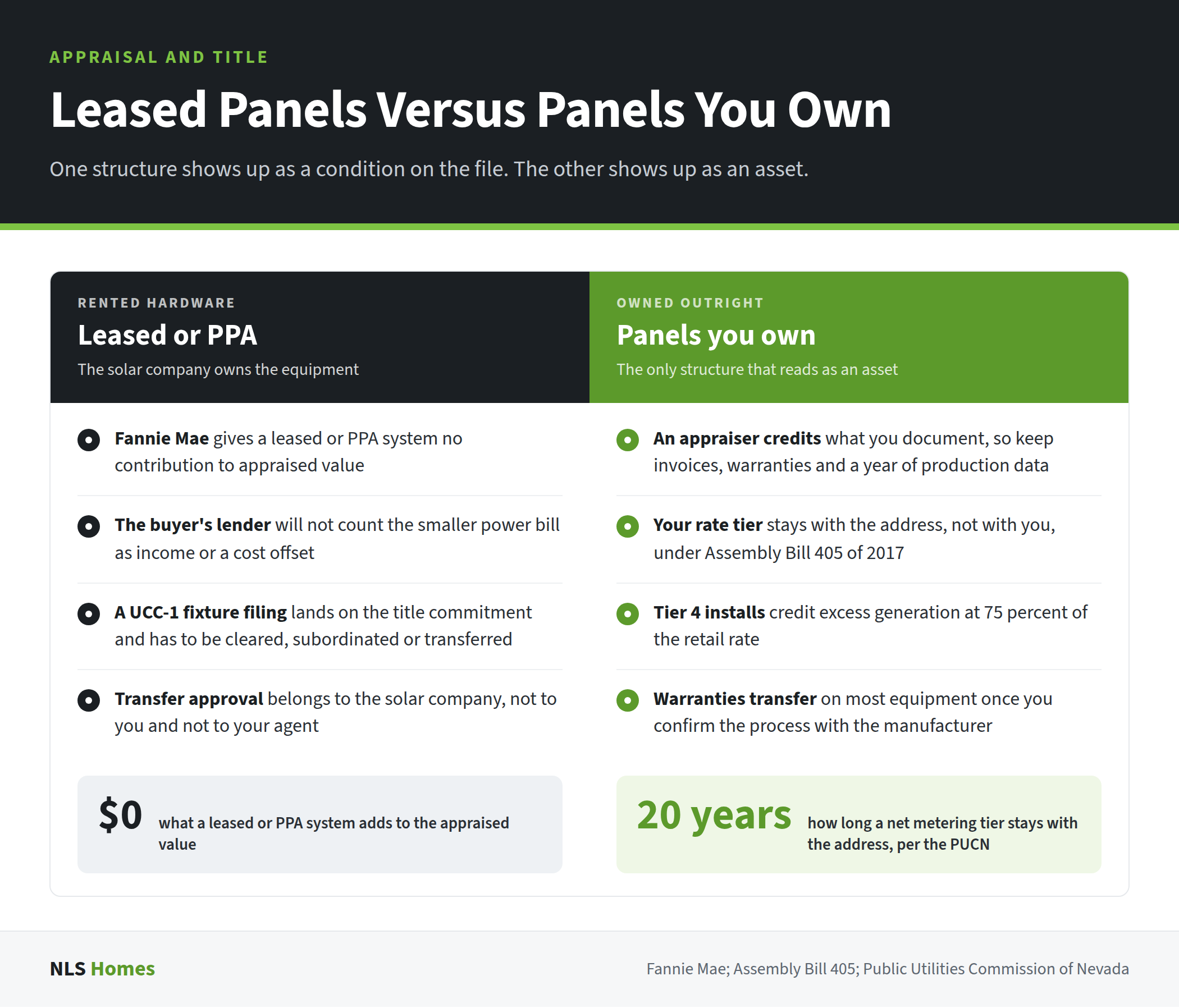
Appraisers won’t help you here. Under Fannie Mae’s guidelines, a leased or PPA system contributes nothing to appraised value, because the borrower doesn’t own the equipment. Your mortgage lender also won’t count the smaller power bill as income or as a cost offset when qualifying the buyer. So the panels add zero to the appraisal and add a payment to the buyer’s monthly budget.
Then the title commitment lands on your desk. The solar company’s UCC-1 fixture filing shows up as a requirement that has to be cleared, subordinated, or transferred before the deed can move.
How much patience a buyer brings to all this depends on the market. Las Vegas inventory climbed to roughly 8,100 active single-family homes as of September 2026, with about 4.7 months of supply on hand. Buyers aren’t fighting over houses. Given three comparable homes in Silverado Ranch, which one do you think a buyer skips?
A few years back, three siblings came to me after inheriting their mother’s place in Spring Valley. Two agent listings had expired with zero offers. Every showing note mentioned the leased panels and the payment attached to them. Her sewing room was still set up in the second bedroom when we walked it, and I notice that kind of thing in almost every inherited house I buy.
What Are Your Options with a Leased Solar System?
Get this part wrong and you find out in week five of escrow, when the buyer’s lender refuses to fund over a filing nobody addressed. Sales die there, and the seller eats another mortgage payment plus a relist.
You’ve got four realistic paths. The buyer assumes the lease, which means the solar company’s transfer department runs a credit check and issues an assumption agreement signed at closing. You buy out the remaining contract and have the filing terminated, which delivers clean title and owned panels. The provider subordinates its filing so the new mortgage sits in first position. Or you sell to a buyer who takes the contract as-is without blinking.
That last option is why cash buyers exist in this niche. It’s also how NLS Homes buys homes, since we treat the lease as one more term to price, not a reason to walk. We’ve handled leases like this before, and we’re not asking a mortgage underwriter for permission.
Transfer approval belongs to the solar company. It isn’t yours to grant, and it isn’t your agent’s either. If the buyer’s credit score falls below the provider’s threshold, the assumption dies, and you’re back to a buyout or a new buyer.
My honest opinion on relocation clauses: read yours before you believe anyone who says a lease can simply be moved. Some providers will remove and reinstall a system at a new property. The cost lands on you, and panels rarely fit a different roof the same way.
How Much Does a Solar Lease Buyout Cost in Las Vegas?
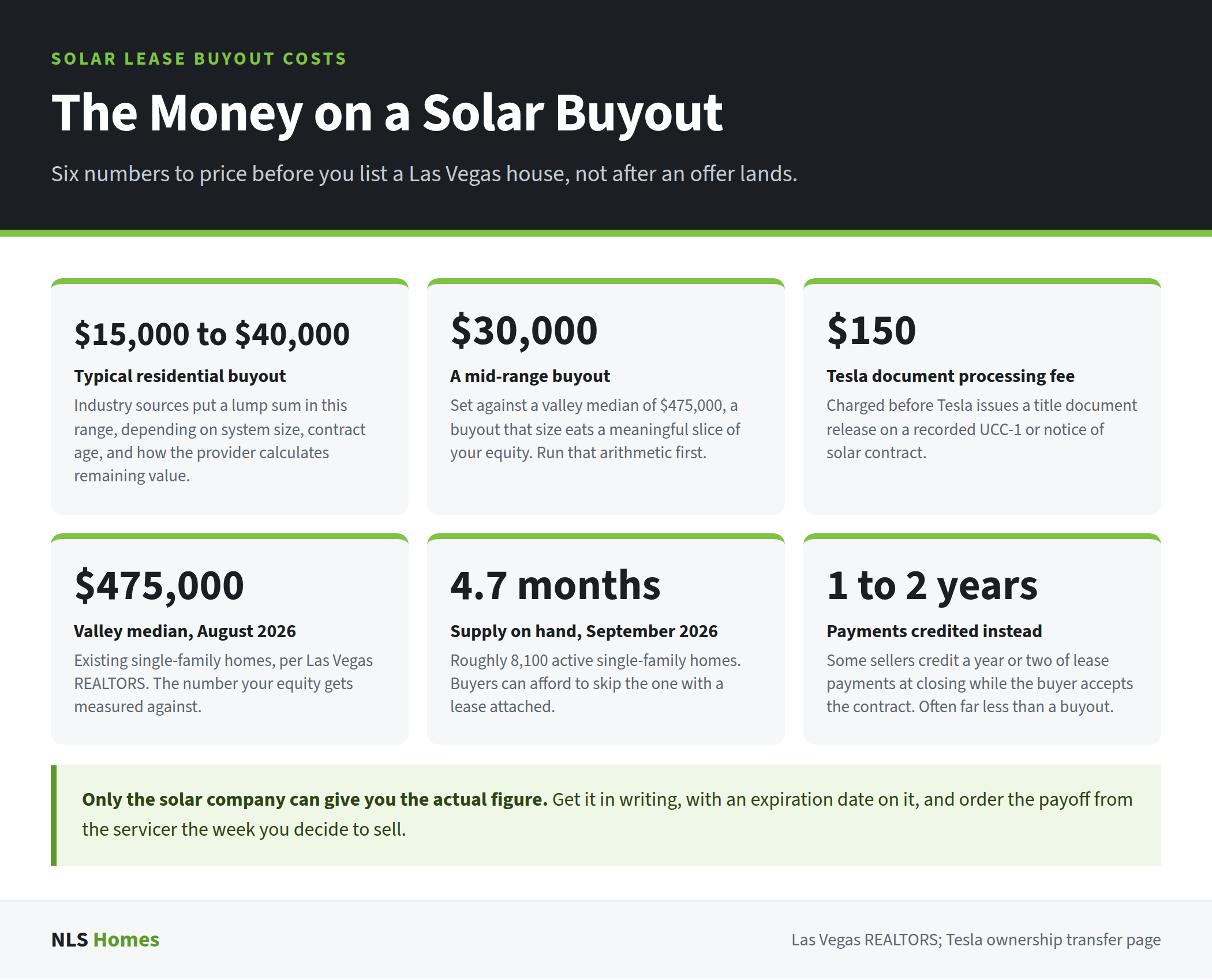
Which brings up the number every seller wants first. Industry sources put typical residential buyouts somewhere between $15,000 and $40,000 as a lump sum, depending on system size, contract age, and how the provider calculates remaining value. Only the solar company can give you the actual figure. Get it in writing, with an expiration date on it.
Against a valley median of $475,000 for existing single-family homes in August 2026, per Las Vegas REALTORS, a $30,000 buyout eats a meaningful slice of your equity. That’s the arithmetic nobody runs before calling an agent.
Here’s my stance, and plenty of listing agents will disagree. A full buyout only makes sense when the panels are relatively new, the system is sized right for the house, and you can document production. Buying out a tired ten-year-old array to make a stalled listing look better is usually money you won’t recover at the appraisal.
Expect to pay a little extra for paperwork. Tesla, for one, charges a $150 document processing fee before issuing a title document release on a recorded UCC-1 or notice of solar contract. Any outstanding balance has to be settled at or before closing.
Sometimes a split works better than all or nothing. I’ve watched sellers negotiate one where the buyer accepts the lease and the seller credits a year or two of payments at closing. That often costs far less than a buyout, and it gets everyone to the table.
What Are Financed Panels and Ucc Filings?
A seller in Enterprise thought her panels were paid off, because the installer’s welcome packet said “your system.” Title pulled the prelim and found an active financing statement with a five-figure balance still attached.
Think of a solar loan as debt, because that’s exactly what it is. The lender protects itself with a UCC-1 financing statement, commonly filed with the Nevada Secretary of State’s office, and that filing names the equipment as collateral. Some solar lenders go further and record a deed-of-trust lien against the real property itself. And that one’s a lot harder to unwind.
Providers will tell you a fixture filing isn’t a lien. Tesla states plainly on its ownership transfer page that a UCC-1 is a notice of who owns the system, not a lien against the home. Releasing or subordinating it for financing purposes is common practice.
Title companies and mortgage lenders don’t much care about that distinction. Because the panels count as fixtures, the filing can read as an encumbrance on the whole parcel, and it blocks a lender’s first-lien position until somebody resolves it.
Resolution runs one of three ways. Pay off the balance and get a UCC-3 termination recorded, transfer the contract with the provider’s written consent, or obtain a subordination. Order your payoff figure from the solar servicer the week you decide to sell. Solar servicers move slowly, and a promised termination is not a recorded termination.
Do Owned Solar Panels Help You Sell Your Las Vegas House?
“So I spent thirty grand on panels and now you’re telling me it’s a wash?” No. Owned systems genuinely help, and they’re the only structure that shows up as an asset instead of a condition.
They just don’t repay dollar for dollar. An appraiser credits what’s documented, so dig out your invoices, the interconnection approval, inverter warranties, and a year of production data before you list.
Sellers tend to undersell net metering when they list a solar home. Nevada’s tiered structure came out of Assembly Bill 405 in 2017. According to the Public Utilities Commission of Nevada, a customer keeps the rate tier they signed up under for twenty years, at the location where the system was installed. Newer installations sit at Tier 4, which credits excess generation at 75 percent of the retail rate.
Translation for your listing: an older grandfathered system at a richer credit rate is worth advertising, because that tier stays with the address rather than with you.
NV Energy notes on its solar page that rooftop incentives are no longer available and that interconnection now runs through its PowerClerk application. A buyer who wants solar in 2026 can’t recreate your terms from scratch. For a paid-off array on a west-facing roof near the 215, that’s a real selling point.
Warranties transfer too, on most equipment. Confirm the transfer process with the manufacturer, and hand the buyer a folder rather than a shrug.
Can You Sell a Las Vegas House with Solar for Cash?
Yes, you can sell to somebody who doesn’t care about the panels. For some sellers that’s the cleanest exit available.
A cash sale removes the mortgage underwriter from the equation, which erases the first-lien argument that stalls so many of these transactions. It also removes the appraisal, so the leased system stops being a zero-value item on a form. Title still has to address the filing, and any experienced local buyer, myself included, handles that directly with the solar company’s transfer department.
Speed is the other piece. About 1,730 single-family homes closed across Las Vegas and Henderson in the most recent thirty-day reporting period logged in September 2026, down from roughly 1,950 the month prior. Fewer closings mean longer waits for sellers who list, and a leased system stretches that wait further.
We’ve bought houses in Sunrise Manor and Desert Shores where the lease was the entire reason the owner called, and we buy houses in Enterprise too. When we take one on, we either assume the contract ourselves or negotiate the buyout into the offer. Either way the seller stops carrying the payment, and that relief matters more to most people than the payoff number. Homeowners who want that conversation without a listing agreement attached can reach out to NLS Homes for a straight read on the numbers.
Cash offers come in under retail, and I won’t pretend otherwise. The comparison that matters is net proceeds against time. A slightly lower number in three weeks beats a higher one in four months with a buyout carved out of it.
Should You Lease Solar Panels If You Plan to Sell Your House?
Escalator clauses get glossed over at the kitchen-table sales appointment. Many leases raise your monthly payment a few percent every year for the life of the contract. The payment a buyer inherits in year twelve looks nothing like the one you signed in year one.
Would you sign a twenty-year contract on a house you plan to leave in four?
My position is simple. If a sale is likely within five years, either buy the system outright or leave the roof alone. Leases pencil out for people who genuinely intend to stay put, in a home sized right for the system.
Tax treatment follows ownership, not occupancy. Whoever owns the equipment claims any federal credit that’s available, so with a lease or PPA that benefit belongs to the solar company. That’s part of how they price the contract. Federal rules here have shifted, so verify current eligibility with a tax professional before you count on anything.
One more thing worth weighing is roof age. Replacing shingles or tile under a leased array means paying a removal and reinstall fee to the provider. I’ve watched that surprise wreck a seller’s repair budget right before listing.
If you’re already locked into a contract, none of this is a scolding. It’s context for the decision in front of you, and plenty of Las Vegas homes with leases close every month without drama.
What Should You Do Next Before Listing Your Las Vegas Home?
Plenty of sellers figure their agent will handle the solar paperwork once an offer comes in. Then the offer arrives with a fourteen-day inspection period, the provider’s transfer department estimates three to four weeks for approval, and the two timelines start fighting each other.
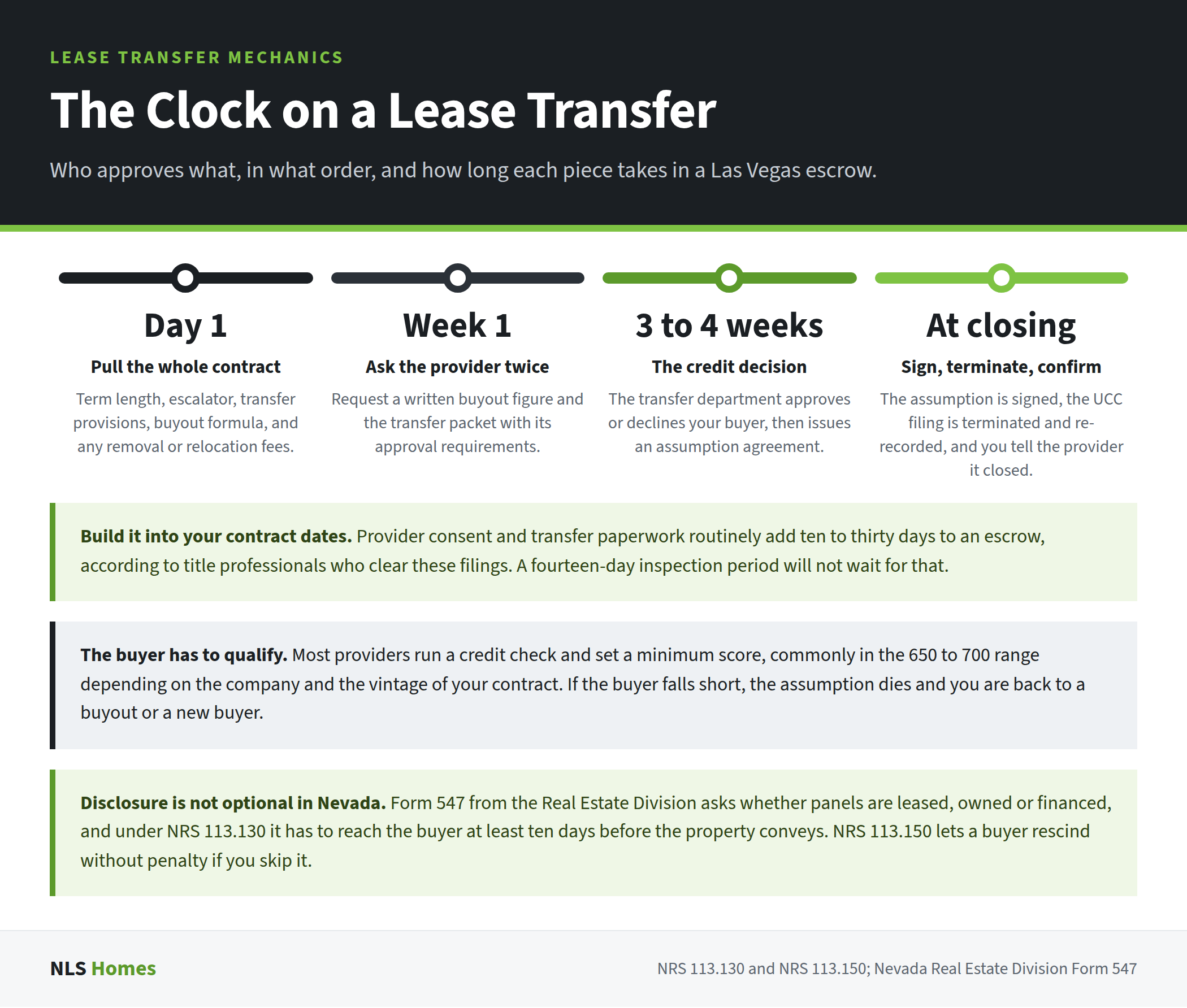
Start with the contract itself, all of it, including the exhibits most people never opened. You’re looking for the term length, the escalator, the transfer provisions, the buyout formula, and any removal or relocation fees.
Then request two written documents from the provider: a current buyout figure and the transfer packet with its approval requirements. Those two pieces let you price the house honestly instead of guessing.
Disclosure is not optional in this state. Nevada’s Seller’s Real Property Disclosure, Form 547 from the Real Estate Division, asks whether solar panels are installed and whether they’re leased, owned, or financed. Under NRS 113.130, that completed form has to reach the buyer at least ten days before the property conveys.
Skipping it hands your buyer a weapon. NRS 113.150 lets a buyer rescind the agreement without penalty any time before conveyance if the seller failed to serve that disclosure properly. Nondisclosure of a known defect can expose you to a damages claim afterward.
Ask your title company to run a UCC search alongside the standard title search. Catching a fixture filing on the prelim beats discovering it during the funding call. At NLS Homes that’s the first thing we check on any solar property.
Lease Transfer Mechanics: Who Approves What, and When
A seller in Rhodes Ranch had a signed contract, a pre-approved buyer, and a closing date circled on the calendar. The solar provider’s transfer approval took longer than the buyer’s loan, and the escrow extension nearly cost him the sale.
Sequence is everything. The buyer completes the provider’s credit application, the provider approves or declines, and an assumption agreement gets signed at or before closing. The UCC filing is terminated and typically re-recorded in the new owner’s name. Title coordinates most of that, but somebody has to start it, and that somebody is usually you.
Provider consent and transfer paperwork routinely add ten to thirty days to an escrow, according to title professionals who clear these filings for a living. Build that into your contract dates instead of hoping for the best.
Interconnection paperwork with the utility often needs updating too, since the net metering account follows the service address and the new customer of record.
One step sellers forget is to notify the solar company once the sale actually closes. Providers rely on escrow or the seller to confirm the closing date. A missed confirmation is how people end up getting bills for panels on a house they no longer own.
If your agent tells the buyer the transfer is a formality, correct them. It’s a credit decision made by a third party with no stake in your closing date. Treating it casually is how a Friday funding turns into a Monday problem.
Getting the Order Right on a Las Vegas Solar Sale
Four hundred ninety thousand dollars was the peak median for existing single-family homes in this valley, set in May and June of 2026. Prices drifted slightly below that through late summer. That softening is exactly why sequencing matters more now than it did two years ago.
List first and sort out the panels later, and you’ll spend your best marketing weeks answering questions you can’t answer.
Work it the other way. Documents first, provider figures second, pricing third, listing or direct sale fourth. A seller who can hand a buyer a transfer packet and an approval timeline on day one keeps control of the negotiation.
Pricing deserves its own thought. A leased system with a low payment and a decent escalator is an easy sell to a buyer who understands utilities in a Las Vegas August, when the air conditioning runs all day. A payment above what the panels realistically offset is a liability, and the price should reflect that rather than pretending otherwise.
Keep a fallback ready. If assumption fails on credit, know in advance whether you’ll fund the buyout, offer a payment credit, or pivot to a cash buyer.
Sellers near Sunset Park and out in Centennial Hills ask me whether they should just wait for a better market. Waiting costs you monthly payments on a contract that escalates, and the lease doesn’t pause while you think about it.
Selling a House with Leased Solar Panels in Las Vegas: Where Do You Start?
Start with the truth about your contract, because every other decision depends on it, and guessing helps nobody.
Pull the agreement, call the provider’s transfer line, and write down what they tell you along with the name of who told you. From there the choice is genuinely simple: transfer it, buy it out, or sell to somebody who’ll take it as it stands. All three close sales in this valley every month.
Your situation might not fit the traditional listing model at all. Inherited homes, rentals with tenants, tired roofs, relocations on a deadline: these are the sales where a lease question becomes the least of your problems. A straightforward cash sale often beats four months of showings and a nervous buyer’s lender.
Frequently Asked Questions
Can I sell a house in Las Vegas with a solar lease still on it?
Yes. Nevada sees these closings every week. You either transfer the agreement to the buyer, pay it off before or at closing, or sell to a buyer who accepts the contract as written. The lease is an obstacle to plan around, not a wall.
Does the buyer have to qualify for the lease?
Almost always. Most providers run a credit check and set a minimum score, commonly in the 650 to 700 range depending on the company and the vintage of your contract. Approval is the provider’s call, not yours and not your agent’s. Start that application early rather than a week before funding.
How long does a solar lease transfer take?
Plan on two to four weeks from a complete application, though some providers move faster and some take longer during busy months. The delay is rarely the credit decision itself. It’s the missing documents, the unsigned assumption packet, and the closing-date confirmation nobody sent over.
Will leased panels raise my sale price?
Rarely in a direct way. Owned systems can add value. Leased systems mostly shift a monthly cost from you to the next owner, and buyers price that payment against what it actually saves on an NV Energy bill. A low payment on a productive system is a selling point. A high payment on an aging system is a discount.
What if my buyer won’t take the lease at all?
Then you’re looking at a buyout funded from the proceeds, a credit that covers the buyer’s first few years of payments, or a different buyer. Know which of those you’re willing to do before you’re sitting in escrow. That’s when pressure makes people agree to things they regret.
Is there a lien on my house from the panels?
Often there’s a UCC-1 fixture filing against the equipment rather than a mortgage-style lien on the property. Title will flag it. The provider typically subordinates or releases it as part of a transfer, but it has to be handled on paper, and it takes time.
If you’d rather skip the showings, the lender conditions, and the wait on a transfer approval, it’s worth knowing what a cash sale on your place would look like. No obligation, and no pressure to decide anything today. Reach out when you want a straight answer about your options, whether you’re in Las Vegas or looking for cash buyers in Henderson, and we’ll talk through the contract you actually have.