
If a Notice of Default is taped to your front door right now, you’ve got plenty of company across the valley.
Most of what goes wrong happens in the first three weeks after that notice lands. People stop opening mail. They wait for a servicer to call back. The statutory clock keeps running toward an auction whether anyone picks up the phone or not.
A Notice of Default isn’t an eviction notice, and it doesn’t mean the house is gone. It’s the opening move in a sequence with defined steps. Nearly every one of those steps leaves you room to act, as long as you know where you’re standing in it. The homeowners who lose the most aren’t the ones with the worst finances. They’re the ones who guessed at the timeline instead of confirming it.
What follows is the map. You’ll see what Nevada law hands you, what your mortgage lender will and won’t do, and how homeowners from Spring Valley to Sunrise Manor have stopped a trustee sale before it happened.
Which Path Leads to a More Stable Financial Future?

A homeowner in Centennial Hills was five months behind on her mortgage in the spring, with a sale date already published. By early summer she’d closed a sale, kept roughly forty thousand dollars of her equity, and signed a lease on an apartment near Durango.
Same house. Same debt. Completely different ending, because she moved while she still had choices.
Nevada homeowners facing foreclosure usually fix on “can I keep the house.” That’s the wrong first priority. The better one is which exit leaves you standing in two years with your savings intact and a credit file a landlord will approve.
Equity is the reason this matters so much in Las Vegas right now. Las Vegas REALTORS reported a median price of $475,000 for existing single-family homes sold across Southern Nevada in August 2026. That’s about 1 percent under August 2025, and $15,000 below the all-time high of $490,000 set in May and June of 2026. Prices have flattened, not collapsed, which matches what I’ve seen walking through houses this year. A homeowner who bought in 2019 or 2020 is very likely sitting on real money.
Figuring your own number isn’t complicated, and you should do it on paper before you make a single phone call. Start with a realistic sale price, not the Zestimate and not what your neighbor got in a bidding war two summers ago. Subtract the payoff figure from your servicer, which covers more than the principal balance. Subtract closing costs, any second mortgage or HELOC, any HOA balance in collections, and anything owed to a contractor who recorded a lien. What’s left is what you’re actually protecting.
That money disappears at a trustee sale. The auction satisfies the debt, and anything above it goes through the trustee’s hands. By then late charges, trustee fees, and attorney costs have eaten a chunk of it. Selling first keeps you in charge of the number.
Fighting to keep a house you genuinely can’t afford is the most expensive form of hope I run into. I’ve watched families burn a year of savings on partial payments that never reinstated the loan, then lose the property anyway.
Try this test. Write down your household income as it exists today, not the version where the overtime comes back. Write down the full housing payment including taxes, insurance, and HOA. If that payment eats more of your income than it did when you qualified for the loan, and nothing on the income side is scheduled to change, keeping the house isn’t a plan. It’s a delay you’re paying for out of savings you’ll need for a deposit later.
Can a Trustee Sale Be Stopped Once It’s Scheduled?
Miss the window, and the sale happens. Nevada gives no right of redemption after a non-judicial foreclosure sale, so there’s no buying it back next month once the trustee’s deed records.
Several things can halt a scheduled auction. A bankruptcy filing triggers an automatic stay, which freezes collection activity, including a trustee sale, the moment the petition hits the court docket. That stay isn’t permanent, and a creditor can ask the bankruptcy judge to lift it. Still, it buys breathing room measured in weeks or months rather than days.
Reinstating the loan stops it too, assuming you can cover the arrears plus fees. A completed sale of the property stops it, and that’s the route most sellers I meet end up choosing. Joining Nevada’s foreclosure mediation program pauses the trustee’s ability to move forward for owner-occupied housing until the process finishes.
Postponement deserves its own paragraph, because homeowners assume it’s automatic and it isn’t. A trustee postpones when the beneficiary says to, and the beneficiary says so only when a documented reason sits in the file. In practice that means a fully executed contract to buy, the escrow officer’s name and number, a title company file number, and an estimated closing date. Send all of it to the trustee and the servicer’s loss mitigation department together. Email it, fax it if a fax number is listed, then call the next morning to confirm a human received it. A signed contract nobody at the servicer has seen does nothing for you.
One trap worth knowing: an open bankruptcy case disqualifies you from the state mediation program, per the eligibility terms published by Home Means Nevada. You pick a lane.
A couple of years ago, three siblings shared a house out near Desert Shores. The one whose name sat on the deed got transferred out of state with five weeks to report. The loan was already in default, and the garage held a decade of camping gear plus a dead jet ski. I’ve walked enough of these to know the clutter never tells you much, so we walked it on a Saturday morning. We closed before the sale date and the siblings split what was left.
Timing is the whole game: five weeks was tight but workable, whereas five days would not have been.
Can Free Legal Help in Las Vegas Change Your Outcome?
For years I told homeowners that calling the servicer was the first move, and that advice was half wrong. A HUD-approved counselor gets further in one call than borrowers get in ten.
Nevada law forces the lender to hand you those phone numbers, so it isn’t something they can skip. A Notice of Default on a small residential property must include contact information for someone with authority to negotiate a loan modification, along with a HUD-approved housing counseling agency and the mediation program. Free counseling through agencies listed on HUD.gov costs you nothing, and it creates a paper trail your attorney can use later.
Clark County residents also have the Civil Law Self-Help Center, which publishes plain-English walkthroughs of the whole foreclosure and mediation process along with the actual forms. Nevada Legal Services handles foreclosure prevention work for qualifying households. Neither one will charge you a retainer.
Why do so few homeowners use them? Shame, mostly. Losing a home in a town built on winners and losers carries a sting that keeps people quiet until the notice goes up on the door and the neighbors see it.
Skip the outfits advertising on Boulder Highway billboards promising to “stop your foreclosure now” for an upfront fee. Legitimate counseling in Nevada is free, and any operation asking for money before it does anything deserves your suspicion.
Sellers need documents more than sympathy in this process. Bring your note, your deed of trust, every statement since you fell behind, and the notices you’ve received. A counselor who can see the real loan amount and the real arrearage can tell you in one sitting whether a modification is realistic.
Go in with questions written down, because the appointment moves fast. Ask whether your loan is government-backed or held by an investor, since that determines which workout programs exist for you at all. Ask what documents the servicer will require for a modification review, and how long that review typically takes with your particular servicer. Ask whether your mediation election window is still open, and what the filing looks like if it is. Ask what the counselor has seen this servicer actually approve, not what the brochure says. I’ve sat in on calls where the brochure promised flexibility the servicer never once delivered. Then ask for everything in writing, including the counselor’s name and direct line. You’ll need to reference that conversation later, when a call center representative tells you no file exists.
Putting Your Options in the Right Order
A landlord in Rhodes Ranch called me after his tenant stopped paying and his own mortgage went three payments behind. He’d spent six weeks arguing with a servicer chatbot before anybody told him the Notice of Default had already recorded.
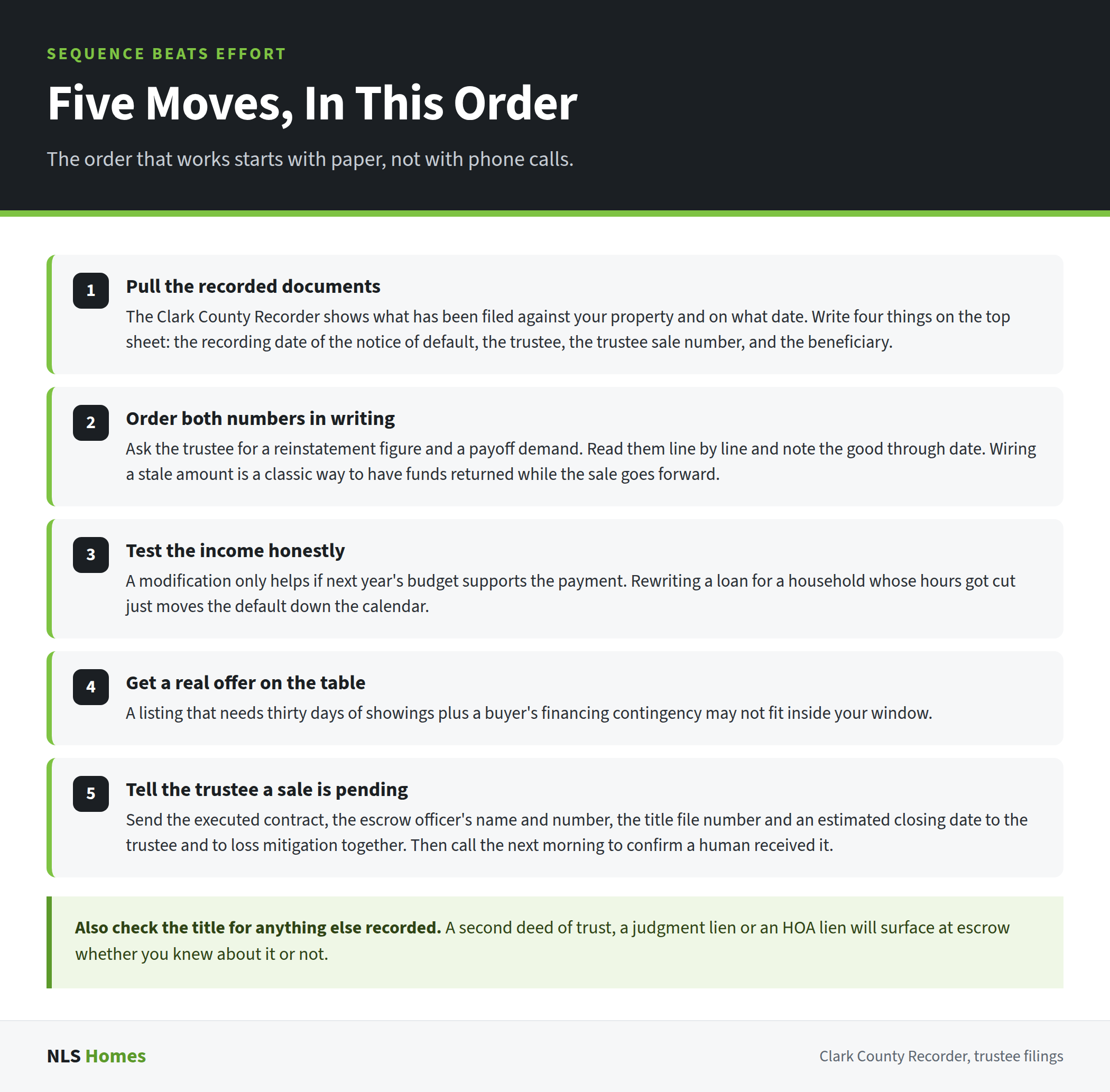
Sequence beats effort. The order that works starts with paper, not phone calls.
Pull the recorded documents first. The Clark County Recorder’s office shows exactly what’s been filed against your property and on what date, which tells you where you sit in the statutory timeline. Everything else depends on that date.
When you pull them, note four things and write them on the top sheet. Those are the recording date of the notice of default, the name of the trustee, the trustee sale number, and the name of the beneficiary. That trustee sale number is the single most useful string of characters you own. Every call you make about postponement, reinstatement, or payoff goes faster when you lead with it, something I learned after making plenty of those calls myself. Also check for anything else recorded against the title, because a second deed of trust, a judgment lien, or an HOA lien will surface at escrow whether you knew about it or not.
Second, get a written reinstatement figure and a written payoff demand from the trustee. Those two numbers are the difference between “I can fix this” and “I need to sell.” They include the fees nobody warns you about, and they change monthly as costs are added.
Read it line by line rather than skipping to the total, a habit I picked up after seeing buyers miss a stale figure. You’ll see the missed principal and interest, escrow shortage for taxes and insurance, late charges, and then the foreclosure costs: trustee fees, recording, publication, posting, property inspections. Note the “good through” date. Past that date the number is no longer valid, and wiring a stale amount is a classic way to have funds returned while the sale goes forward.
Third, decide honestly whether the underlying income problem is solved. A modification only helps if next year’s budget supports the payment. Rewriting a loan for a household whose hours got cut at a casino property just moves the default down the calendar.
Fourth, if the answer is sell, get a real offer on the table fast. This is where a direct buyer earns their keep, because a listing that needs thirty days of showings plus a buyer’s financing contingency may not fit inside your window. We’ve had homeowners call NLS Homes with three weeks left and still close, though I’d rather have a month more than that.
Last, tell the trustee in writing that a sale is pending. Lenders postpone auctions for signed contracts more often than people expect, but only if somebody sends the file.
What Are the Foreclosure Laws in Nevada?
Let me say it the way I’d say it across your kitchen table. Nobody is taking your house next week, and nobody is going to give you a year either.
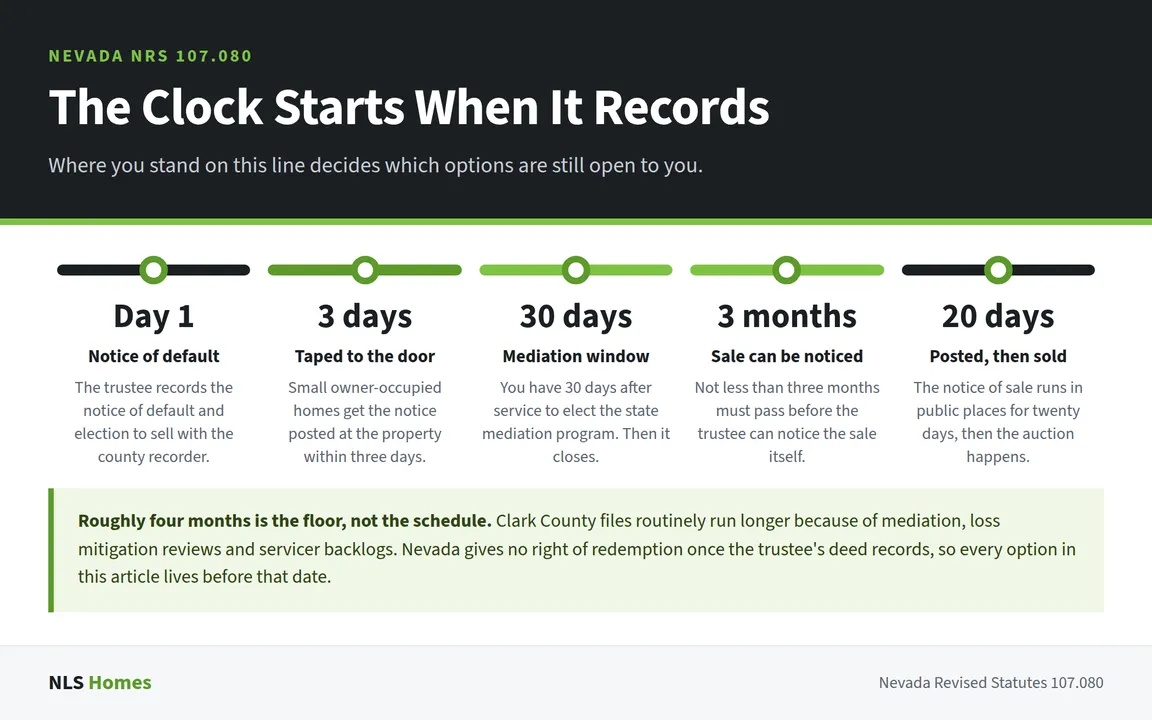
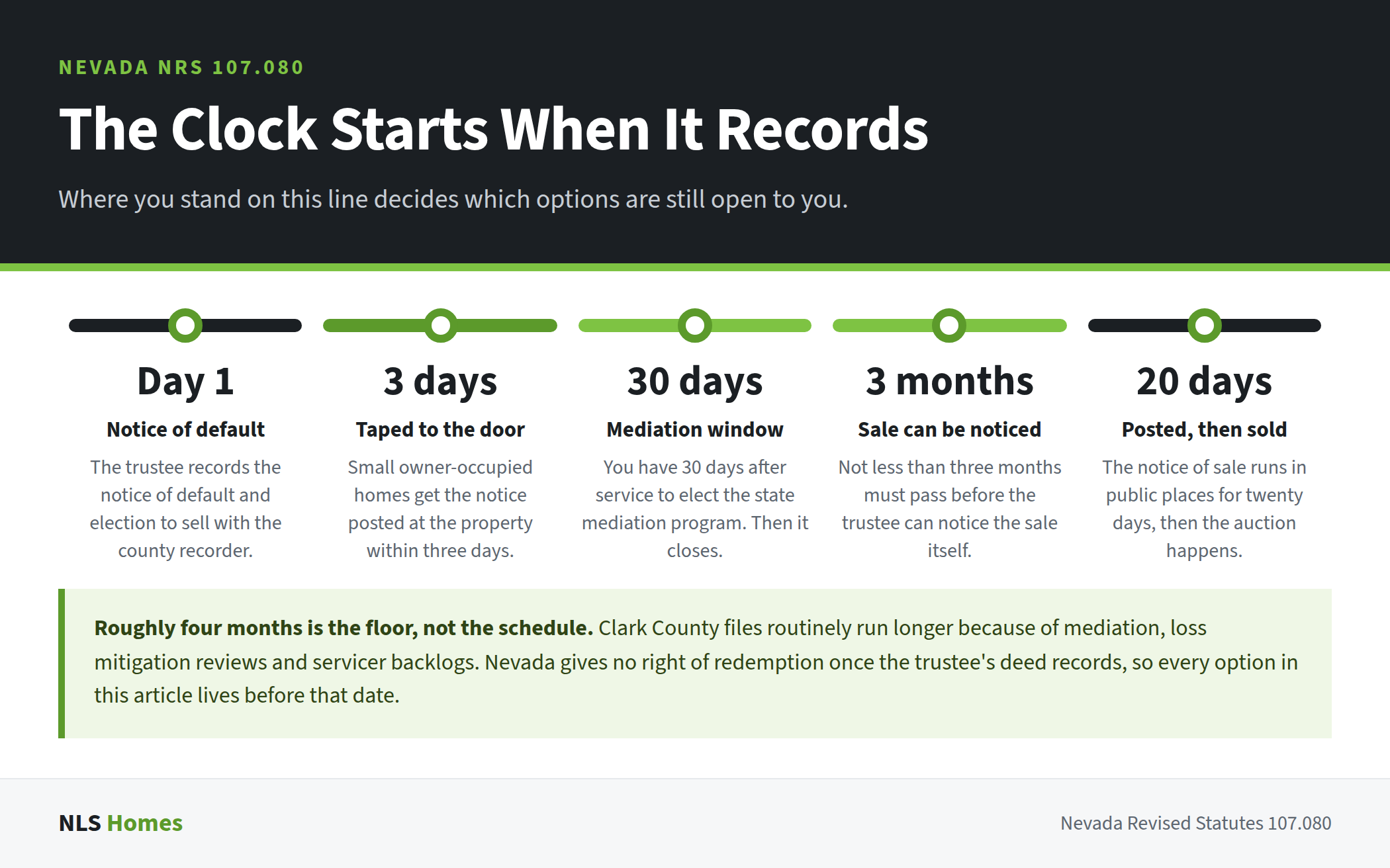
Nevada is a non-judicial foreclosure state. Your deed of trust hands the trustee a power of sale, so the lender doesn’t have to sue you in court to foreclose. Under NRS 107.080, the trustee records a notice of default and election to sell with the county recorder. Not less than three months must pass after that recording before the trustee can give notice of the sale itself.
That three-month floor is the single most useful fact in this article. It’s a minimum, not a maximum. Clark County files routinely run longer because of mediation, loss mitigation reviews, and servicer backlogs.
The statute also builds in a cure period that starts the day after the notice of default is recorded and mailed to the borrower. For small owner-occupied residences, the notice has to be posted on the property within three days of recording. So the copy taped to your door is part of the legal machinery, not a scare tactic.
It helps to know who’s who on that paperwork, because homeowners waste weeks calling the wrong office. Your servicer is the company you’ve been mailing payments to, and they handle modifications, forbearance, and loss mitigation. The trustee is a separate company, usually a foreclosure processing firm. They handle the sale date, the postponement, the reinstatement figure, and the payoff demand. The beneficiary is whoever truly owns the loan. Asking the servicer to postpone a sale gets you transferred. Asking the trustee to approve a modification gets you transferred the other direction. Keep both numbers on the same sheet of paper and use the right one.
Before the auction, the notice of sale gets recorded, mailed, posted in public places for twenty days running, and published in a newspaper. The trustee can postpone the sale, but Nevada limits how many times before the process restarts. Call the trustee’s office listed on your notice to confirm the current date; that number is on the document.
One more thing about a completed non-judicial sale in Nevada: it’s final as to the title. There’s no post-sale redemption period the way some states allow, which is why everything in this article points at the days before the gavel.
What Happens During a Foreclosure in Las Vegas?
You might figure the bank wants your house. It doesn’t. Banks are terrible landlords and worse resellers, and a repossessed property in Enterprise sitting vacant through July with the pool going green costs them real money.
What happens instead is a grinding administrative sequence. Payments get missed and late fees post. Somewhere around the third or fourth month, the servicer sends a breach letter demanding the full arrearage. Then the file goes to a foreclosure trustee, who records the notice of default with the county recorder, mails it certified, and posts it at the property.
Owner-occupied borrowers also receive a notice about the right to petition the district court for mediation assistance. If you don’t pursue mediation, Home Means Nevada issues a certificate of foreclosure roughly sixty to ninety days after service of the notice of default, and the trustee proceeds from there.
Inside the servicer, your file typically moves to a loss mitigation department, and depending on the company you may be assigned a point of contact. Get that person’s name, extension, and email the first time you reach them. Then document everything: date, time, who you spoke with, what they committed to, and what they asked you to send. Servicers lose documents. Not maliciously, usually, but a modification packet that goes missing in week three costs you a month you can’t spare. A call log is the only thing that lets you prove you sent it the first time. Send documents through the servicer’s portal when one exists, and save the confirmation screen.
After that comes the notice of trustee sale with a specific date, time, and place. Auctions in Clark County happen in person, often at a trustee’s office or a designated public location, and the property goes to the highest bidder. Cash, same day, no inspection contingencies.
Volume gives you a sense of the pressure. Lenders started foreclosure on 26,648 properties nationwide in July 2026, about 10 percent more than the same month a year earlier. Nevada sat at the top of the per-household rankings that month.
Nothing in that sequence happens quietly, by the way. Your mailbox fills up with letters from investors, attorneys, and loan modification shops within a week of the notice recording. Default filings are public record, and a small industry in Las Vegas is built on watching them.
Some of those letters are from legitimate buyers and some are not, so pay close attention to what they’re asking you to do. A real buyer asks to see the property and sends a contract. Anyone asking you to sign a deed, pay a fee before performing, or start sending your mortgage payment to them instead of the servicer is a problem. Take that letter to a counselor or attorney rather than to your kitchen trash.
What Challenges Do Las Vegas Homeowners Face During Foreclosure?

The HOA is the piece that sinks more Las Vegas closings than the mortgage does.
Half this valley sits inside an association. Summerlin, Mountain’s Edge, Aliante, Silverado Ranch: when the mortgage goes unpaid, the HOA dues usually go unpaid alongside it, and associations in Nevada have their own lien powers and their own collection agents. A homeowner can resolve things with the mortgage lender and still face a separate association claim with its own fees stacked on top.
Get this sorted early and put it in writing. Request a current statement of account from the management company. If the file has already gone to a collection agent, request the payoff figure from the agent rather than the HOA. Those are two different numbers. Ask specifically what portion is assessments and what portion is collection costs, fines, and interest. I’ve seen balances where the dues themselves were the small part. Escrow will demand a written demand from whoever holds the lien before closing. Tracking that down in the final week of a compressed timeline is exactly the kind of avoidable delay that pushes a closing past a sale date.
Insurance premiums have climbed hard, and so have association assessments for roofs, paint cycles, and street repair. For households on tips or commissions, a slow convention quarter can flip the math in eight weeks.
Condo owners carry an extra weight. The median price for existing condos and townhomes sold in Southern Nevada in August 2026 was $299,900, up 0.6 percent from a year earlier. That’s still under the record $315,000 set back in October 2024. Financing limits on non-warrantable buildings shrink the buyer pool, so a distressed condo near the Strip can take longer to move than a house in the northwest.
If you own a condo, find out now whether your building has litigation, a high investor concentration, or a pending special assessment. Any of those can knock out the financed buyers entirely and leave you dependent on cash offers. Better to learn that in week one than in week six, when a buyer’s lender declines the project.
Inventory adds friction too. At the close of August 2026, 7,590 single-family homes sat listed without a single offer across the valley, a 5.3 percent jump over August 2025, per reporting on the latest Las Vegas REALTORS data. Supply moved to roughly four and a half months. Buyers have options, and they’re using them.
Add the emotional load. Foreclosure lands on people in the middle of a divorce, a layoff at a resort property, a cancer diagnosis. Paperwork feels impossible when your life already came apart.
What Does Foreclosure Really Do to Your Credit Score?
And that emotional load is exactly why people avoid the credit question until it’s too late to manage.
A completed foreclosure lands as a major derogatory item and stays on your report for seven years from the first missed payment that led to it. The score drop varies with where you started. Borrowers with strong credit tend to fall further, because they had more to lose.
What matters more than the number is the shape of the damage. Missed mortgage payments already hurt you before any auction. A borrower who is four months behind has taken most of the hit already, so the remaining question is whether you add a foreclosure notation on top.
Future mortgage eligibility is where it bites. Conventional loans generally impose a multi-year waiting period after a foreclosure, and government-backed programs impose their own. A short sale or a negotiated sale that pays off the debt usually shortens that wait compared with a completed foreclosure. That’s one of the strongest practical arguments for selling before the sale date.
Landlords in Las Vegas run credit too. Property managers here screen hard, and a fresh foreclosure on your report can mean a larger deposit or a flat denial at the complexes with waiting lists.
This practical move costs nothing. Whatever happens with the house, protect everything else on your report. Keep the car loan current, keep one credit card paid on time every month, keep the utilities in your name out of collections. An underwriter reading your file two years from now will treat a single major derogatory against an otherwise clean payment history very differently than a file where everything failed at once. If you do end up apartment hunting with fresh damage, write a short letter of explanation and bring pay stubs and bank statements. Offer to show a rental history from the mortgage servicer’s payment record. Private landlords will listen to a straight story far more often than a leasing office algorithm will.
Deficiency is its own topic, and it’s fact-specific under Nevada law. Whether a lender can pursue you for a shortfall after a trustee sale depends on the loan, the sale price, and statutory limits. So get an attorney’s read on your specific note rather than relying on what your cousin heard.
Why Does Waiting Too Long Make Financial Recovery So Much Harder?
Reinstatement amounts grow every month with trustee fees, publication costs, attorney fees, property inspection charges, and accrued interest added to the arrears. The figure you get in month two and the figure you get in month five are not close.
Sale timing is the other half. In August 2026, Las Vegas homes averaged about 122 days from listing to closing, with the typical home going under contract in roughly 30 days. Do that arithmetic against a three-month statutory floor. You can see how thin the margin gets if you list conventionally after the notice of default records.
Buyer behavior shifts too. Retail buyers who learn a property is heading to auction get nervous, and their lenders get nervous faster. Appraisal and underwriting timelines don’t flex for your trustee’s calendar.
Then there’s the part that costs people the most and shows up on no statement: options quietly expire. Mediation has an election window. Modification reviews take weeks the servicer won’t rush. A short sale needs lender approval that can run a month or more. Wait until the sale is eleven days out and the only lever left is bankruptcy.
I keep seeing the same pattern in homes across the valley. The seller who calls at month two has four or five real choices and usually walks away with money. The seller who calls the week of the auction has one choice and takes whatever it pays.
Picture the same house two different ways. In the first version, the owner calls in month two, orders the payoff, and learns there’s meaningful equity. She lists with a good agent, gets multiple offers, and closes on a conventional loan with time to spare. In the second version, the same owner waits until the notice of sale is posted. Now the listing has to compete with everything else sitting unsold, and buyers are asking why it’s priced to move. The only offers that can close inside the window are cash offers at a discount. Nothing changed about the house. The calendar took the difference.
Property condition deteriorates during the wait as well. Deferred maintenance in this climate moves fast, and a roof or an HVAC unit that failed in August knocks thousands off what any buyer will pay in October.
How Do You Stop a Foreclosure Before the Trustee Sale in Las Vegas?

“Can I still sell if the foreclosure already started?”
Yes, and it’s the most common question I hear. Your name stays on title until the trustee’s deed records after the auction. Until that moment you can sell, refinance, reinstate, or negotiate.
Reinstatement means paying everything past due plus costs in one lump. Payoff means satisfying the entire indebtedness. A loan modification rewrites the terms going forward, and a forbearance agreement delays payments without erasing them. Each of these requires your mortgage lender’s cooperation and a servicer willing to move at your pace.
Mediation is the underused one. The State of Nevada Foreclosure Mediation Program covers owner-occupied houses. Per the Nevada homeowner assistance resources published by the state, you have 30 days after being served with the foreclosure notice to elect to participate. Miss that window and you generally need the lender’s written agreement to get in.
Selling outright is the cleanest exit when the payment no longer fits your income. A short sale works when you owe more than the house is worth, though it’ll need lender sign-off and patience. A deed in lieu of foreclosure hands the property back and ends the matter, usually without any cash to you.
Two complications come up constantly, so let me take them head on. If you have a second mortgage or a HELOC, that lender has to be paid or has to agree to release its lien for a sale to close. Getting that agreement takes time you should start spending now rather than later. And if you’re divorced or separated and both names are still on the deed, both signatures are going to be required at closing. I’ve watched closings die because nobody called the ex until escrow opened. Make that call in week one, even if it’s an unpleasant one.
For homeowners with equity and a tight calendar, a direct sale to cash home buyers in Henderson or across the valley beats all of it on speed. No appraisal, no financing contingency, no repair demands. Buyers like NLS Homes work directly with trustees and title companies to get payoff demands ordered early, which is the step that quietly kills most rushed closings.
You also don’t have to clean anything out, and that matters more than people expect. The families I meet are often stuck on the logistics rather than the money: a garage they can’t face, a parent’s furniture, a house full of thirty years. A cash sale lets you take what you want and leave the rest, and that’s how we buy houses.
What you shouldn’t do is transfer your deed to a stranger promising to “take over payments.” That arrangement leaves the loan in your name and the title in theirs.
Foreclosure or Bankruptcy: Comparing Long-term Outcomes
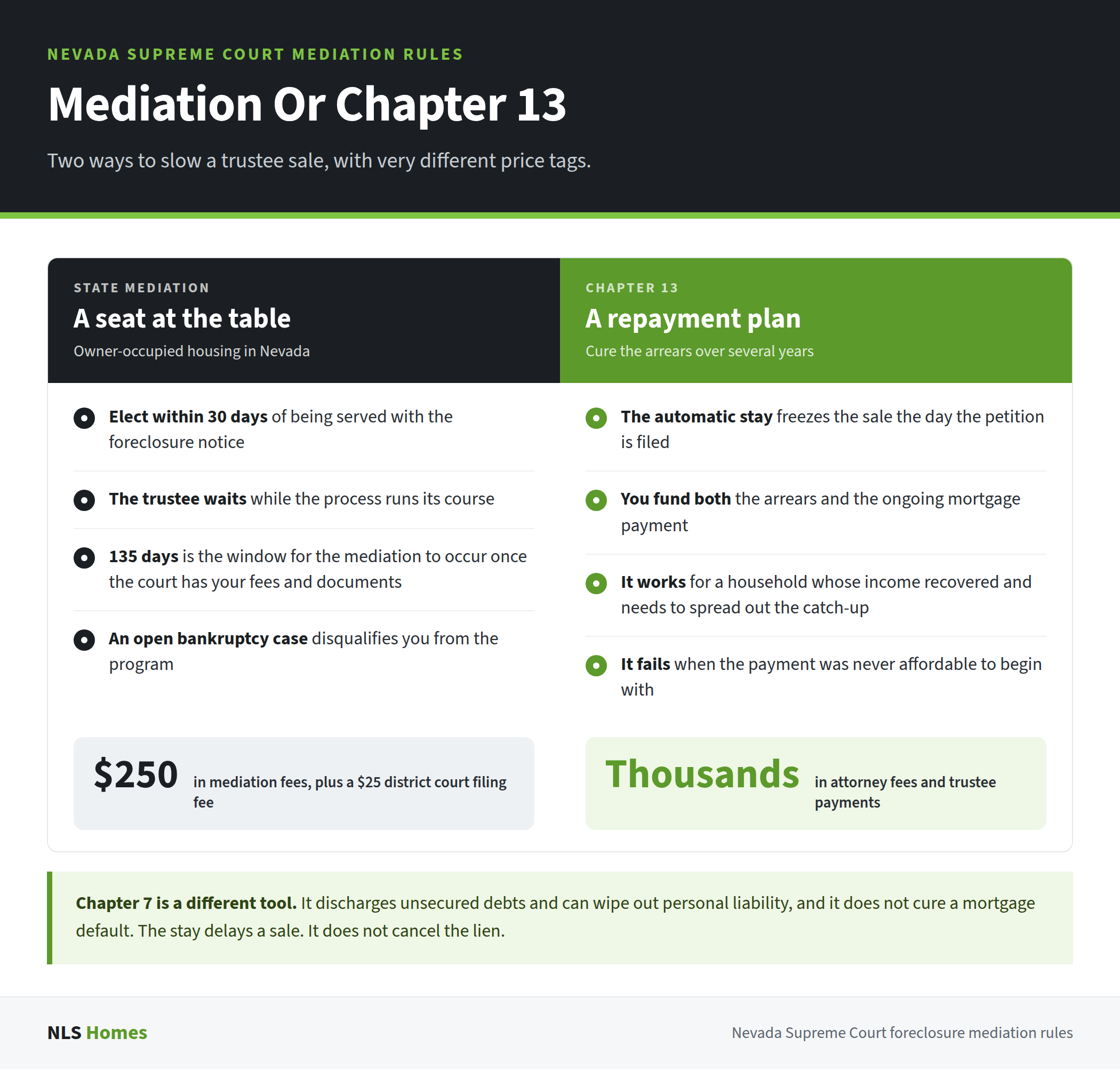
Twenty-five dollars. That’s the district court filing fee for a petition for foreclosure mediation assistance, alongside $250 in mediation fees under the Nevada Supreme Court’s foreclosure mediation rules. The rules call for the mediation to occur within 135 days after the court receives those fees and the required documents. Compare that with a Chapter 13 bankruptcy, where attorney fees and trustee payments run into the thousands.
Bankruptcy has real power, and it’s oversold in this town. Chapter 13 lets you cure mortgage arrears through a repayment plan over several years as you resume regular payments. That works beautifully for a homeowner whose income recovered and who simply needs to spread out the catch-up. It fails for a homeowner whose payment was never affordable, because the plan requires you to fund both the arrears and the ongoing mortgage.
Chapter 7 discharges unsecured debts and can wipe out personal liability, yet it doesn’t cure a mortgage default. The stay delays a sale; it doesn’t cancel the lien.
Either filing sits on your credit report for years and complicates renting, employment screening in gaming positions, and future financing. Foreclosure alone touches fewer parts of your financial life than a bankruptcy does.
My honest read after years of these conversations: bankruptcy is the right tool when the house is affordable and the crisis was temporary. It also fits when you need a stay to finish a sale already in motion. Using it purely to postpone an inevitable loss tends to convert one bad year into three.
Talk to a Nevada bankruptcy attorney before you decide. That consultation is usually free, and the analysis depends on your income, your other debts, and how much equity Nevada’s homestead exemption protects. Bring the same packet you’d bring a counselor, plus a list of every debt you owe and recent pay stubs. Ask three direct questions: which chapter fits my situation, what would my monthly plan payment be, and what happens to my equity if I file. If the answers don’t leave you better off than selling, you have your answer.
Frequently Asked Questions
How long does the foreclosure process take in Nevada?
From the recording of the notice of default to a trustee’s sale, the statutory minimum runs roughly four months. In practice most files take longer once mediation requests, loan modification reviews, or servicer delays enter the picture. Owner-occupied homes generally move slower than investment properties. Don’t treat the extra time as a reprieve, though, treat it as your working window.
Can I still sell my house after I’ve received a notice of default?
Yes. You keep title and the right to sell right up until the trustee’s sale is completed. The payoff simply has to cover the loan balance, accrued interest, late fees, and trustee costs, which is why ordering the payoff demand early matters so much. Closings that fall apart usually fail on paperwork timing, not on price.
Will I walk away with any money if the house goes to auction?
Sometimes, but rarely as much as you’d get selling it yourself. Surplus funds after the lender and junior lienholders are paid do belong to you, and Nevada has a claims process for them. The catch is that auction pricing almost never reflects market value, so equity that would have been yours often evaporates into the discount.
Am I on the hook for the difference if the sale doesn’t cover the loan?
It depends on the loan and the circumstances. Nevada limits deficiency judgments in several situations, particularly for certain loans used to buy an owner-occupied residence, and there are strict deadlines for a lender to pursue one. Because the exceptions are technical, this is a question for a Nevada attorney rather than a message board.
Does bankruptcy damage my credit more than foreclosure?
Generally yes, and it reaches further. A foreclosure hits your mortgage tradeline and your score. A bankruptcy touches nearly every account you have and shows up in background screening that matters in this market, including some gaming and financial licensing reviews. Recovery is possible from both, but the repair timeline after a Chapter 7 or 13 tends to be longer.
What if I’m already within days of the trustee’s sale?
Options narrow but they don’t disappear. Reinstatement, a postponement negotiated through the trustee, a bankruptcy filing, or a cash closing scheduled around the sale date can all still work. What you need is someone who can pull the trustee’s contact, confirm the exact sale date, and tell you honestly whether the calendar allows what you’re hoping for.
If you’re somewhere in this process, you may just want a clear picture of what your house is actually worth and how much runway you have left. That’s a conversation worth having before you commit to anything. NLS Homes will look at your numbers, tell you what a cash sale would net you, and say so plainly if staying put or talking to an attorney serves you better. No obligation, no pressure, reach out to us when you’re ready.